
India X-Ray Market Growth: Trends, Technology, AERB & CDSCO Regulatory Impact
Explore India’s rapidly growing X-ray market driven by AERB regulations, CDSCO compliance, digital radiography, AI integration, and portable imaging technologies.
INDUSTRY INSIGHTS & TECHNOLOGY
3/17/20265 min read
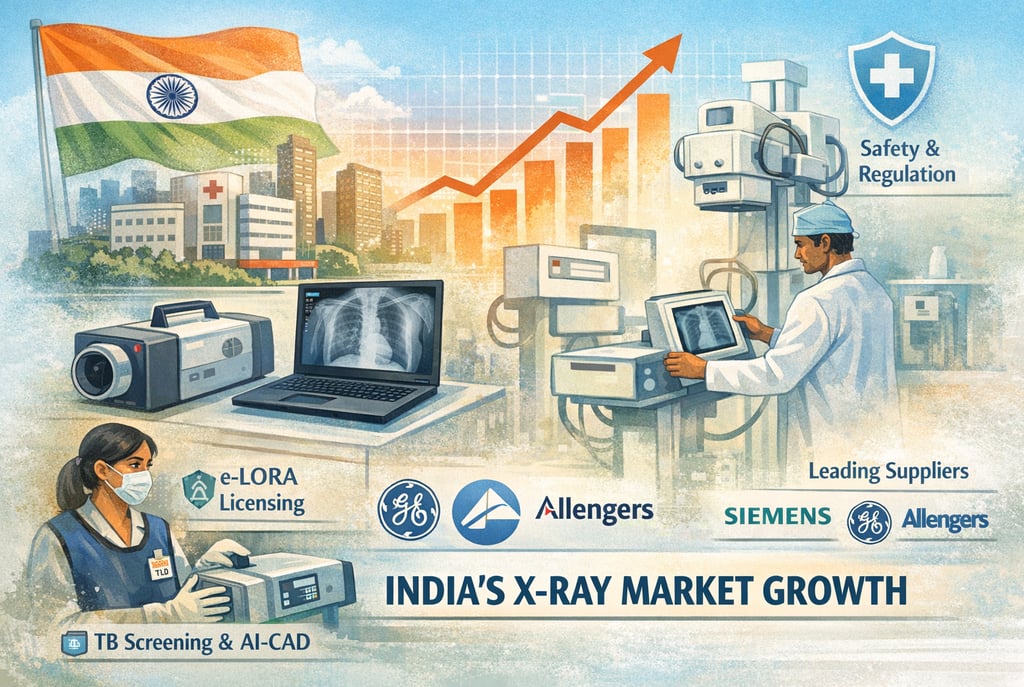
India’s X-Ray Market Growth: A Strategic Evolution Driven by Innovation and Regulation
The Indian diagnostic imaging landscape is currently undergoing a transformative expansion, with the X-ray market serving as its foundational pillar. This growth is not merely defined by an increase in volume but by a sophisticated shift toward high-technology, portable, and digitally integrated solutions. In pursuance of ensuring the safety of occupational workers and the public, the Atomic Energy Regulatory Board (AERB) and the Central Drugs Standard Control Organization (CDSCO) have implemented rigorous frameworks that have matured the market from a fragmented sector into a highly regulated, high-growth industry.
1. Regulatory Standardization as a Market Catalyst
One of the most significant drivers of market maturity and subsequent growth in India was the reclassification of X-ray equipment. As of April 1, 2020, X-ray machines were officially considered "drugs" for regulatory purposes under the Medical Device Rules 2017.
Mandatory Registration: Effective January 1, 2021, all X-ray generating equipment (XGE) requires mandatory registration in India.
Risk-Based Classification: These devices are now categorized as Class C (Moderate to High Risk) medical devices.
Quality Assurance: This regulation was implemented to curb the spurt in misbranded products and inferior-quality devices that previously led to clinical misdiagnosis and inaccurate results.
By standardizing the quality of equipment allowed in the market through CDSCO registration and AERB Type Approval, India has created an environment where international brands and high-quality indigenous manufacturers can compete on a level playing field, boosting investor and provider confidence.
2. The Rise of Ultraportable and Handheld Systems
The market is witnessing a massive pivot away from traditional fixed room installations toward portable and ultraportable (UP) units. This segment is "hot" because it addresses India’s unique geographical and infrastructural challenges.
Technological Shift: Portable equipment is defined by the AERB as units weighing not more than 12 kg that can be carried by one or two persons.
Field Utility: These units are essential for forensic, combat, humanitarian, and emergency operations where access to traditional fixed X-ray sources is unavailable.
Performance Benchmarks: Independent research indicates that modern handheld devices, such as the Nomad Pro, often provide significantly higher mean Line Pair (LP) resolution (6.05–6.55 lp/mm) compared to traditional wall-mounted sources (5.58–6.31 lp/mm) due to smaller focal spot sizes (0.4 mm vs. 0.7 mm).
This technical superiority, combined with the convenience of battery-powered operation, has made handheld X-rays a staple in both private dental practices and large-scale public health initiatives.
3. Public Health Initiatives: The TB Screening Driver
A major portion of the X-ray market’s growth in the coming decade is tied to the National Tuberculosis Elimination Programme (NTEP). India’s mission to eliminate TB relies heavily on systematic and large-scale Chest X-ray (CXR) screening.
Community-Based Screening: Ultraportable systems are designed to fit within a suitcase or backpack, allowing them to be moved regularly to resource-limited areas without stable power supplies.
AI Integration: These systems are increasingly paired with Artificial Intelligence (AI) powered Computer-Aided Detection (CAD) software.
Standardized Interpretation: CAD tools provide automated image interpretation, which is vital in regions where expert human readers are scarce, thus increasing the throughput and demand for X-ray hardware.
Specific implementations, supported by organizations like the William J. Clinton Foundation (WJCF) and the Ministry of Health and Family Welfare, involve the deployment of these "hot" products across dozens of implementation districts in multiple states.
4. Technological Evolution: DR and HF Systems
The transition from analog to digital and the adoption of High-Frequency (HF) generators are technical trends fueling replacement and upgrade cycles in the market.
Digital Radiography (DR) Adoption: Modern systems utilize highly sensitive and dose-efficient LG Oxide Detectors (e.g., 14” x 17” panels).
Dose Optimization: DR systems aim at the optimization of image quality and patient dose, adhering to the ALARA (As Low As Reasonably Achievable) principle.
HF Generators: The shift toward high-frequency constant potential generators (typically operating at 90 kV or higher for CXR) ensures better image contrast and lower patient skin doses compared to older low-frequency systems.
These advancements are encouraging existing facilities to decommission old equipment and invest in digital-first technologies.
5. Market Structure: The Supplier Ecosystem
The Indian market is supported by a robust ecosystem of authorized suppliers, ranging from multinational corporations to powerful local players.
Multinational Giants: Major authorized suppliers include Siemens Healthcare, Wipro GE Healthcare, Philips India, Samsung India Electronics, and Fujifilm India.
Indigenous Leaders: Local manufacturers like Allengers Medical Systems, Allengers Medical Systems, and Skanray Technologies play a critical role in providing affordable, AERB Type Approved equipment.
Specialized Players: Companies like Carestream Health India and Agfa Healthcare focus heavily on the imaging receptor and digital processing side of the market.
The requirement for suppliers to have OEM (Original Equipment Manufacturer) authorization and to provide comprehensive maintenance and training ensures that the market grows through quality service rather than just hardware sales.
6. The Impact of e-LORA and Operational Compliance
The AERB’s e-LORA (e-Licensing of Radiation Applications) portal has digitized the consenting process, making it easier for facilities to procure and operate X-ray units legally.
Streamlined Procurement: The digital application for a Procurement Letter typically takes only a few hours for approval.
Mandatory Quality Assurance (QA): The requirement for periodic QA every two years ensures a continuous demand for testing services and equipment maintenance.
Personnel Monitoring: The mandatory use of TLD (Thermoluminescent Dosimeter) badges and lead aprons (0.25 mm lead equivalence) has created a secondary market for radiation protection accessories.
This structured environment forces hospitals and clinics to maintain high standards, which in turn drives the demand for high-spec, compliant equipment.
7. Safety as a Competitive Advantage
As public and occupational safety awareness grows, clinics that prioritize radiation protection are gaining a competitive edge.
Shielding Requirements: Standardized room layouts (e.g., 1.7 mm lead lining for X-ray room doors) and mandatory safety signage contribute to a professional imaging environment.
Staffing Standards: The requirement for a qualified Radiological Safety Officer (RSO) and trained technologists ensures that machines are operated at optimal parameters, reducing retakes and increasing patient satisfaction.
8. Challenges and Future Outlook
Despite the robust growth, the market faces specific technical and regulatory challenges:
Manual Calibration: Most ultraportable systems lack Automatic Exposure Control (AEC), requiring radiographers to have high expertise to manually adjust mAs based on patient size.
Regulatory Rigor: The mandatory biennial QA and e-LORA updates can be an administrative burden for small clinics.
Field Safety: Managing scatter and leakage radiation in community settings requires strict adherence to Time-Distance-Shielding (TDS) principles, necessitating extensive training for non-radiographer staff.
Conclusion
The India X-ray market is in a phase of dynamic expansion, transitioning from a hardware-centric model to a service-integrated, digital-first industry. Driven by the urgent need for community screening, the introduction of AI-CAD tools, and a rigorous regulatory framework led by the AERB and CDSCO, the market is poised for high double-digit growth. Success in this market is no longer just about the "hot product" but about a deep commitment to Expertise, Authoritativeness, and Trustworthiness (E-E-A-T) through regulatory compliance and patient-centric innovation. As technology continues to miniaturize and AI becomes more integrated, India is likely to emerge as a global leader in point-of-care diagnostic imaging.
About XRAYNNEWS.NET
XRAYNEWS.NET provides updates on medical and industrial X-ray technologies, radiography insights, regulatory awareness, and imaging industry developments.
Regulatory Resources
© 2025. All rights reserved.
Video Resources
Popular Topics
Quick Links
Stay Updated with X-Ray Industry News
Subscribe to receive updates on X-ray technology developments, radiography insights, and industry news.