e-LORA Registration Guide: Step-by-Step AERB Licensing Process for X-Ray Facilities in India
Learn the complete e-LORA registration process for X-ray facilities in India. Understand AERB licensing, QA requirements, shielding standards, RSO roles, and radiation safety compliance.
AERB & REGULATORY GUIDE
3/16/20265 min read
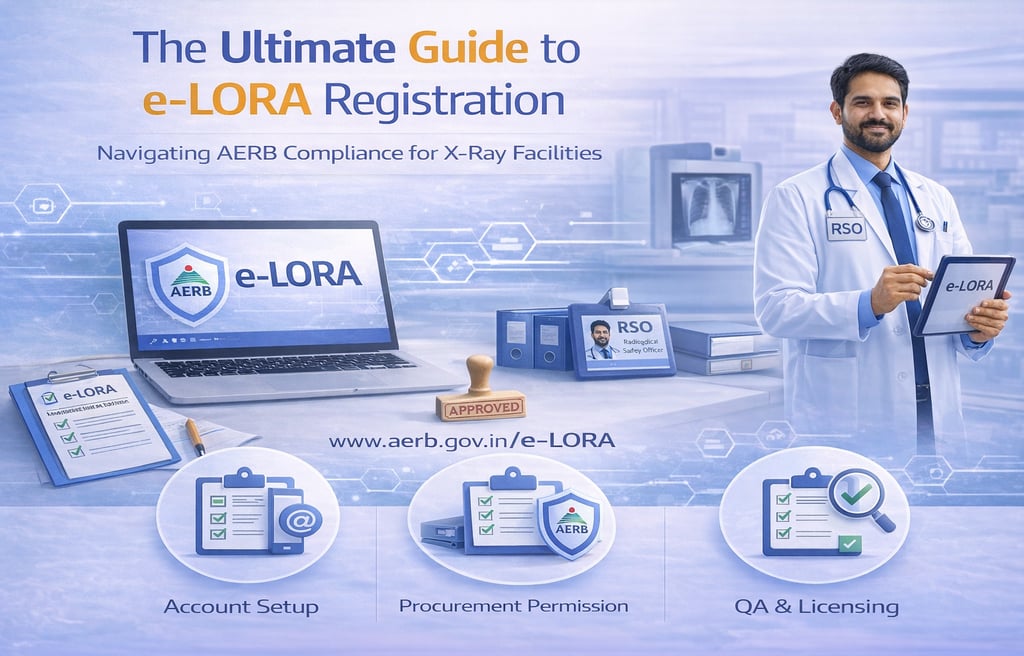
The Ultimate Guide to e-LORA Registration: Navigating AERB Compliance for X-Ray Facilities
In India, the use of X-ray generating equipment (XGE) is governed by a robust legal framework intended to protect occupational workers, the public, and the environment from the harmful effects of ionizing radiation. At the heart of this regulatory system is the Atomic Energy Regulatory Board (AERB) and its specialized web-based platform: e-LORA (e-Licensing of Radiation Applications).
Whether you are setting up a dental clinic, a diagnostic center, or an industrial inspection facility, obtaining a valid Licence for Operation via the e-LORA portal is a mandatory legal requirement under the Atomic Energy (Radiation Protection) Rules, 2004, and the Atomic Energy Act, 1962. This comprehensive guide provides a 1500-word deep dive into the e-LORA registration process, technical benchmarks, and the roles required to maintain a compliant facility.
What is e-LORA?
e-LORA is an electronic platform designed by the AERB to facilitate all regulatory transactions between the Board and the stakeholders. It automates the consenting process for the manufacture, supply, installation, operation, and decommissioning of radiation equipment. No diagnostic X-ray equipment can legally be operated for patient diagnosis or industrial inspection until a valid license is issued through this system.
Pre-requisites for e-LORA Registration
Before logging into the portal, a facility must ensure it meets specific infrastructure and manpower benchmarks.
A. Facility Layout and Shielding
Room Size and Design: The room housing the equipment must have an area that allows for easy staff movement and proper patient positioning.
Structural Shielding: Walls, doors, ceilings, and floors must provide adequate attenuation. Standard X-ray room doors typically require a lead lining of 1.7 mm.
Warning Signs: A permanent radiation warning symbol and instructions for pregnant women must be posted at the entrance door.
B. Staffing and Manpower
Qualified Operators: Facilities must employ radiologists, medical practitioners, or X-ray technologists who have passed from recognized institutions.
Radiological Safety Officer (RSO): Every facility must designate an AERB-approved RSO. For high-risk facilities like CT and Interventional Radiology (IR), the RSO must be a radiologist or a technologist with at least three years of experience.
Age Limit: No person under 18 years of age can be employed as a radiation worker.
C. Safety Tools and Personnel Monitoring
Lead Aprons: Must have a minimum lead equivalence of 0.25 mm.
TLD Badges: Every radiation worker must use personnel monitoring services (TLD badges) to track their annual effective dose, which should not exceed 20 mSv (averaged over five years).
The Step-by-Step e-LORA Registration Process
The registration process is divided into several distinct phases, from initial institute registration to final operational licensing.
Phase 1: Institute Registration
Portal Access: Visit the official AERB website (www.aerb.gov.in) and click on the "e-LORA System" button.
Account Creation: Click on "Register Institute" and fill in the required details, including the registered email and mobile number.
Role Identification: Identify the Employer (the custodian of the equipment) and the Licensee (responsible for establishing safety procedures).
Phase 2: Procurement Permission (Procurement Letter)
Before purchasing equipment, the institute must obtain a "Procurement Letter" from the AERB.
Form Selection: Log in and navigate to Regulatory Forms >> Medical Diagnostic Radiology >> Procurement of X-ray Equipment.
Model Identification: You must select an AERB Type Approved model and identify an authorized supplier from the AERB-provided list.
Required Info: Details include the type of equipment (fixed, mobile, or portable), the expected workload, and the intended purpose (medical diagnosis or industrial inspection).
Approval: Approval for procurement typically takes a few hours to a few days.
Phase 3: Receipt, Installation, and Quality Assurance (QA)
Once the equipment arrives at the facility, the following steps are mandatory:
Intimation of Receipt: The facility must inform the AERB through e-LORA upon receiving the device.
Installation: An engineer from the authorized supplier must install the unit and generate an Installation Report.
Mandatory QA Test: A third-party agency authorized by the AERB must conduct a functional performance check. The equipment must meet specific tolerances:
Operating Potential (kVp): Within ± 5 kV.
Timer Accuracy: Error must not exceed ± 10%.
Radiation Leakage: Must be < 1 mGy in one hour at 1 meter for general units, and < 0.25 mGy/hour for dental IOPA units.
Phase 4: Licence for Operation
This is the final regulatory hurdle before you can begin diagnosing patients.
Upload Documents: Log into e-LORA and upload the Installation Report, the QA Summary Report, and the Detailed QA Report.
Submission: Select the equipment ID from the drop-down menu, agree to the terms and conditions, and submit the application.
Approval Timeline: approval usually takes around 30 days. The registration certificate can then be downloaded from the "My Casefile" tab.
Special Registration Modules
A. Dental Radiology Users
The e-LORA portal has a dedicated module for dental practitioners.
Indigenous vs. Imported: There are separate pathways for equipment manufactured in India versus those imported from abroad.
Mandatory Fields: Dental users must provide MDS/BDS qualification details and declare the availability of protective accessories like lead aprons and leakage levels as mentioned in the QA report.
B. Ultraportable and Field Systems
For equipment used in community screening (e.g., ultraportable handheld units for Tuberculosis screening), registration is often facilitated through a State Single Point of Contact (SPOC) and the District TB Officer (DTO). These units are registered to a specific health facility (e.g., a District Hospital) even if used in the field.
CDSCO and Class C Classification
A critical update to the regulatory landscape occurred on January 1, 2021. Under the Medical Device Rules 2017, all X-ray machines in India are now classified as Class C (Moderate to High Risk) medical devices.
Mandatory CDSCO Registration: Manufacturers and importers must register with the Central Drugs Standard Control Organization (CDSCO) before production or import.
Goal: This regulation was implemented to prevent the proliferation of inferior quality or mis-branded products that could lead to misdiagnosis.
Maintaining Compliance: Post-Licensing Responsibilities
Registration is not a one-time event. Ongoing compliance is vital for Expertise, Authoritativeness, and Trustworthiness (E-E-A-T).
Periodic Quality Assurance: The end-user must ensure that QA is repeated once every two years, or after any major repair, by an authorized agency.
TLD Monitoring: Used TLD badges must be returned quarterly to the BARC-approved service provider for dose reporting and replacement.
Licence Renewal: The Licence for Operation must be renewed before its expiry date via the e-LORA portal.
Decommissioning: When the equipment is no longer functional, it must be decommissioned by an authorized agency with prior intimation to the AERB.
Offences and Penalties
Non-compliance with AERB and e-LORA guidelines is a serious matter. Under the Atomic Energy Act, 1962, any person who contravenes the terms of their license or operates without one is punishable.
Penalties: These can include the suspension or cancellation of the license, financial fines, and imprisonment, depending on the severity of the offence.
Conclusion
The e-LORA registration process is a rigorous but essential journey for any facility utilizing X-ray technology in India. By following the systematic pathway—from Institute Registration and Procurement Permission to Quality Assurance and final Operational Licensing—healthcare and industrial providers ensure that their diagnostics are of the highest quality while maintaining the absolute safety of their staff and the public.
Staying compliant with AERB guidelines and CDSCO Class C standards not only fulfills a legal mandate but establishes your facility as an authoritative and trustworthy leader in diagnostic excellence. Consistent bi-annual QA testing, religious use of personnel monitoring, and strict adherence to the ALARA (As Low As Reasonably Achievable) principle are the hallmarks of a truly professional radiation installation.
About XRAYNNEWS.NET
XRAYNEWS.NET provides updates on medical and industrial X-ray technologies, radiography insights, regulatory awareness, and imaging industry developments.
Regulatory Resources
© 2025. All rights reserved.
Video Resources
Popular Topics
Quick Links
Stay Updated with X-Ray Industry News
Subscribe to receive updates on X-ray technology developments, radiography insights, and industry news.