
Technology & Safety in Modern X-Ray Systems | AERB Compliance & ALARA Guide
Explore modern X-ray technology and safety in India. Learn ALARA, HF generators, DR imaging, and AERB compliance for safe and efficient diagnostics.
INDUSTRY INSIGHTS & TECHNOLOGY
4/21/20265 min read
10 Compliance Mistakes X-Ray Facilities Must Avoid
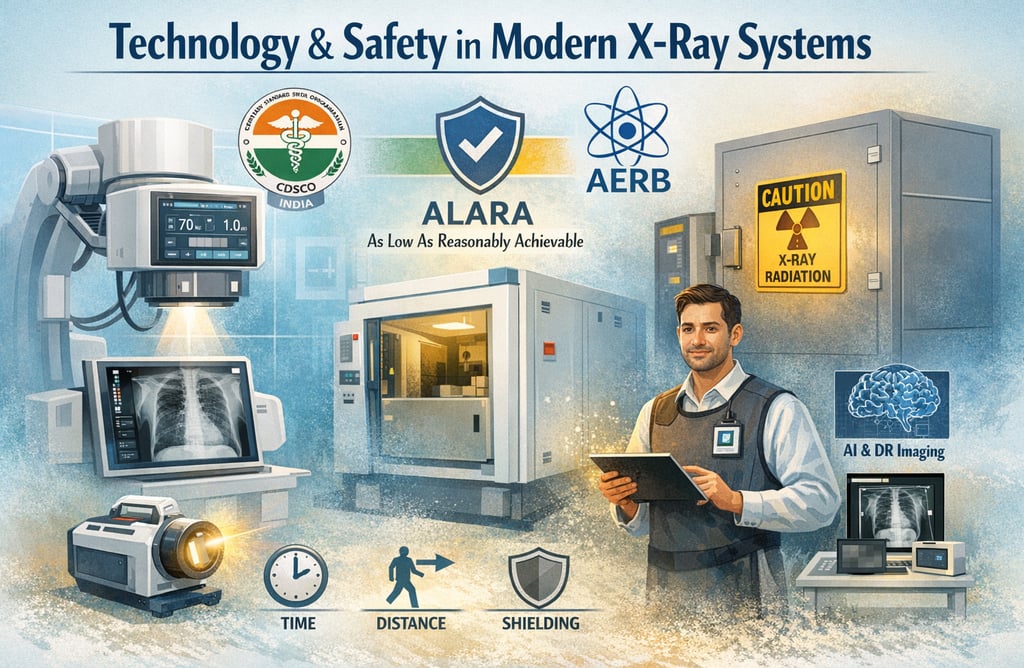
The medical and industrial utilization of X-rays has proven immensely beneficial to society, yet the inherent biological risks of ionizing radiation necessitate a rigorous approach to safety. The mission of the Atomic Energy Regulatory Board (AERB) is to ensure that the use of ionizing radiation in India does not cause undue risk to human health or the environment. Achieving this requires that proper care is exercised throughout the entire life cycle of the equipment—from manufacture and supply to operation and decommissioning. Modern X-ray systems are now designed as highly sophisticated tools that integrate "built-in safety" features with advanced digital technology to fulfill the international principle of ALARA (As Low As Reasonably Achievable).
1. The Foundation of Safety: Regulatory Classification and Mandatory Registration
In India, the regulatory landscape underwent a landmark shift to ensure that only high-quality diagnostic tools reach the public.
Medical Device Classification: Since January 1, 2021, X-ray machines have been classified as Class C (Moderate to High Risk) medical devices under the Medical Device Rules 2017.
CDSCO Oversight: All manufacturers and importers must register X-ray equipment with the Central Drugs Standard Control Organization (CDSCO). This mandate was implemented to curb the proliferation of misbranded and inferior-quality products that lead to clinical misdiagnosis and inaccurate reporting.
Legal Framework: The safety standards are governed by the Atomic Energy (Radiation Protection) Rules, 2004, promulgated under the Atomic Energy Act, 1962.
2. Built-in Safety: Engineering Excellence in Design
Modern X-ray systems are engineered with specific hardware features intended to minimize stray radiation and optimize the primary beam.
A. X-Ray Tube Housing and Leakage Limits
The X-ray tube housing is a shielding enclosure designed to define the useful beam and limit radiation levels outside of it.
Standard Radiography: Leakage through the housing must not exceed 1 mGy in one hour at 1 meter from the focus.
Specialized Units: Stricter limits apply to dental intra-oral (IOPA) units (0.25 mGy/hr) and mammography units (0.02 mGy/hr).
Self-Shielded Systems: For industrial or security cabinets (like XBIS), radiation levels at 10 cm from the external surface must be within 1 µSv/h.
B. Beam Filtration and Quality
Filtration involves placing radiation-attenuating material in the path of the beam to absorb "soft," less-penetrating X-rays that increase patient dose without aiding the image.
Mandatory Standards: Systems operating at constant potential must have a total filtration of at least 2.5 mm Al equivalent.
Impact: This ensures the "radiation quality" of the beam, significantly reducing unnecessary patient exposure.
C. Collimation and Light Fields
X-ray tubes must be provided with a beam-limiting device (collimator) to restrict the field to the area of interest. Modern systems feature a light field indicator showing the center and borders of the field, which must align within strict tolerances (typically <1.5° for central beam alignment) to prevent image distortion and unnecessary dose to sensitive organs.
3. The High-Frequency Advantage: Constant Potential Generators
A major technological advancement in modern systems is the transition from conventional low-frequency generators to high-frequency (HF) constant potential units.
Waveform Efficiency: Conventional units produce pulsating waveforms where voltage drops between pulses, creating useless low-energy radiation. HF generators maintain a constant potential, ensuring the tube operates at peak voltage (kVp) throughout the exposure.
Dose Reduction: Research simulations indicate that transitioning to HF handheld units can lead to a significant reduction in patient effective dose—recorded at 36 µSv for HF handhelds compared to 98 µSv for conventional wall-mounted units in dental examinations.
Optimized Exposure: HF systems allow for shorter clinical exposure times (e.g., as low as 0.16s for anterior projections), which reduces the risk of motion artifacts and patient dose.
4. Digital Transformation: DR Panels and Image Resolution
The integration of Digital Radiography (DR) detectors, such as LG Oxide Detectors, has revolutionized field diagnostics.
Focal Spot Size: The ability to resolve fine anatomical detail is heavily dependent on the effective focal spot size. Modern HF units often feature smaller focal spots (0.4 mm) compared to traditional units (0.7 mm).
Line Pair (LP) Resolution: A smaller focal spot results in significantly higher mean LP resolution (6.05–6.55 lp/mm for handhelds vs. 5.58–6.31 lp/mm for fixed sources), providing superior clarity for complex diagnoses.
AI and CAD Integration: Ultra-portable systems are increasingly paired with Artificial Intelligence (AI) powered Computer-Aided Detection (CAD) software. These tools provide automated, standardized interpretation, which is vital in regions where expert human readers are scarce, particularly for Tuberculosis (TB) screening.
5. The Rise of Ultra-Portable (UP) Systems and Field Safety
UP systems, defined by AERB as equipment weighing no more than 12 kg, have enabled community-based screening in resource-limited settings.
Field Protocol: Because these units are used outside of lead-lined rooms, safety is maintained through the Time-Distance-Shielding (TDS) principle.
Safe Distances: Operators must maintain a minimum distance of 2 meters from the source. In open fields, an area should be cordoned off so the dose at 30 meters does not exceed 5 µSv per scan.
Operator Protection: Radiographers are mandated to wear lead aprons (minimum 0.25 mm lead eqv) and thyroid collars.
6. Specialized Industrial and Security Applications (XGE-REIA)
Regulatory design for research, education, inspection, and analysis (REIA) equipment focuses on self-shielding and fail-safe mechanisms.
Fail-Safe Mechanisms: Modern systems must be designed so the beam de-energizes automatically if any malfunctioning occurs or if an emergency stop switch is activated.
Safety Interlocks: Cabinet doors and access panels must have electrical interlocks that terminate X-ray emission immediately if opened.
Proximity Sensors: Handheld industrial devices (like XRF units) are equipped with proximity sensors that prevent activation unless the object to be scanned is at the correct distance.
7. Quality Assurance (QA): Maintaining Authoritative Standards
The performance of X-ray equipment must be verified periodically to ensure it remains within mandatory tolerances.
QA Periodicity: The end-user is responsible for ensuring periodic QA is carried out by authorized agencies once every two years or after major repairs.
Technical Benchmarks:
kVp Accuracy: Within ± 5 kV of the set value.
Timer Accuracy: Error not to exceed ± 10%.
Output Consistency: The Coefficient of Variation (CoV) must be < 0.05.
Linearity: The Coefficient of Linearity (CoL) for radiation output must be < 0.1.
8. Institutional Roles and Digital Compliance (e-LORA)
The AERB manages the entire regulatory lifecycle through the e-LORA (e-Licensing of Radiation Applications) portal.
Stakeholder Roles:
The Employer: The custodian of the equipment with ultimate responsibility for radiation safety.
Radiological Safety Officer (RSO): A qualified professional (e.g., radiologist or trained technologist) approved by the Competent Authority to implement safety protocols and monitor doses.
Radiation Worker: Personnel mandated to wear TLD (Thermoluminescent Dosimeter) badges (below the lead apron) and undergo periodic safety training.
Dose Limits: Annual whole-body dose limits are set at 20 mSv for occupational workers (averaged over 5 years) and 1 mSv for the public.
Conclusion: Trust Through Transparency and Technology
Modern X-ray technology represents a sophisticated fusion of high-frequency power, digital precision, and rigorous regulatory design. By adhering to the standards set by the AERB and CDSCO, facilities demonstrate Expertise, Authoritativeness, and Trustworthiness. Whether through smaller focal spots that enhance LP resolution or advanced HF generators that slash patient dose, the goal remains the optimization of diagnostic information at the lowest possible radiation risk. Ultimately, safety is not merely a technical specification but a culture of continuous monitoring, periodic Quality Assurance, and religious adherence to the principles of radiation protection. Failure to comply with these guidelines is a punishable offense under the Atomic Energy Act, 1962, emphasizing that in the world of modern radiology, safety is the primary mandate for public health.
About XRAYNEWS.NET
XRAYNEWS.NET provides updates on medical and industrial X-ray technologies, radiography insights, regulatory awareness, and imaging industry developments.
Regulatory Resources
© 2025. All rights reserved.
Video Resources
Popular Topics
Quick Links
Stay Updated with X-Ray Industry News
Subscribe to receive updates on X-ray technology developments, radiography insights, and industry news.