
AERB Guidelines for X-Ray Installations in India: Licensing, QA Benchmarks & Radiation Safety Compliance
Understand AERB guidelines for X-ray installations in India, including e-LORA licensing, QA benchmarks, shielding requirements, RSO responsibilities, and radiation safety standards for compliant operation.
AERB & REGULATORY GUIDE
3/16/20265 min read
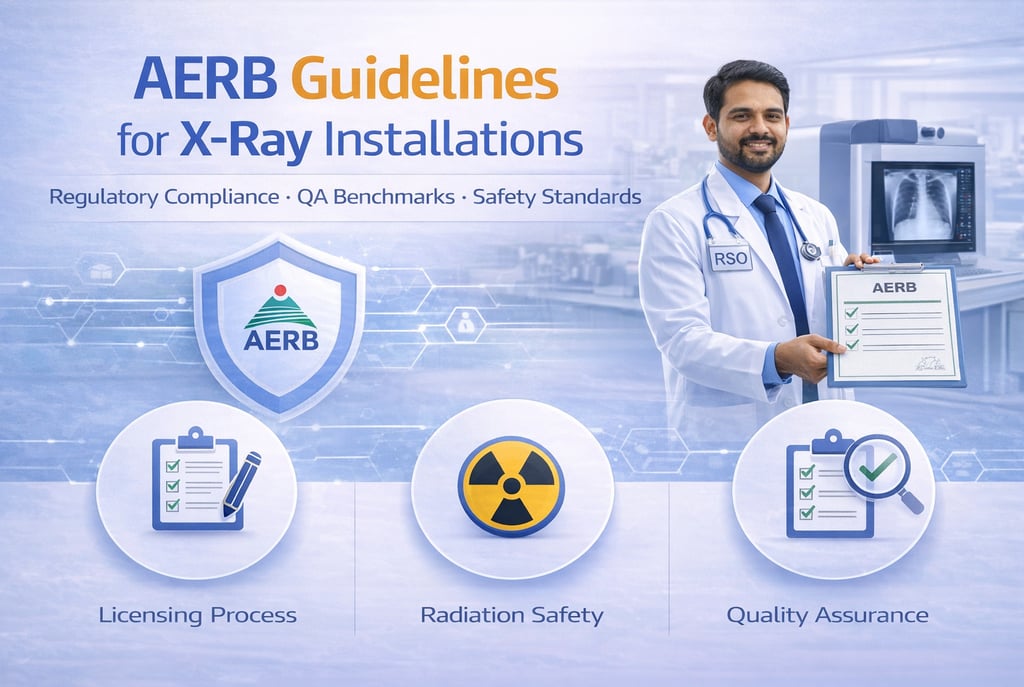
A Comprehensive Guide to AERB Guidelines: Navigating Regulatory Compliance for X-Ray Installations
The Atomic Energy Regulatory Board (AERB) was constituted in 1983 to carry out regulatory and safety functions under the Atomic Energy Act, 1962. Its core mission is to ensure that the use of ionizing radiation and nuclear energy in India does not cause undue risk to human health or the environment. For any facility handling X-ray generating equipment (XGE), whether for medical diagnostic purposes or industrial inspection, adherence to AERB guidelines is a strict legal mandate. This article provides an exhaustive overview of the technical benchmarks, licensing processes, and safety protocols mandated by the AERB.
The Regulatory Framework and Scope
The legal basis for radiation safety in India is provided by the Atomic Energy (Radiation Protection) Rules, 2004, promulgated under the 1962 Act. AERB issues Safety Codes, Standards, Guides, and Manuals that establish mandatory requirements for the entire lifecycle of X-ray equipment, including manufacture, supply, installation, operation, and decommissioning.
The AERB guidelines cover a wide range of modalities, including:
Medical Diagnostic Equipment: Fixed, mobile, and portable radiography units; Computed Tomography (CT); Interventional Radiology (IR); C-Arm; Mammography; and Bone Mineral Densitometers (BMD).
Dental Systems: Intra-oral Peri-apical (IOPA), Panoramic (OPG), and Dental Cone Beam CT (CBCT).
Security and Research (XGE-REIA): X-ray Baggage Inspection Systems (XBIS), X-ray Diffractometers (XRD), and X-ray Fluorescence (XRF) devices.
Essential Design Requirements for Equipment
AERB mandates that manufacturers and suppliers ensure equipment meets specific "built-in safety" design benchmarks to prevent accidental exposure.
Generic Technical Benchmarks
X-Ray Tube Housing: The housing must be constructed so that radiation leakage does not exceed 1 mGy in one hour at a distance of 1.0 meter from the target for standard radiography units. For dental IOPA units, the limit is stricter at 0.25 mGy/hour.
Beam Filtration: Total filtration must be at least 2.5 mm Al equivalent for equipment operating at constant potential to cut off low-energy components that contribute to patient dose without aiding the image.
Collimation: Every unit must have a beam-limiting device that provides a light field indicating the center and borders of the X-ray field.
Exposure Control: The control console must have a manual trigger or preset timer that allows for the immediate termination of the beam. For mobile and portable units, the exposure cable length must not be less than 2 meters to ensure operator safety.
Security and Industrial (XGE-REIA) Specifications
Self-shielded security units, such as XBIS, must ensure that leakage radiation does not exceed 1 µSv/h at a distance of 10 cm from any accessible external surface. These systems must also include "fail-safe" mechanisms and door interlocks that automatically de-energize the X-ray beam if any cabinet door is opened.
The e-LORA Licensing Process
AERB governs the consenting process through the e-LORA (e-Licensing of Radiation Applications) web portal. No X-ray equipment can be legally operated for patient diagnosis or industrial inspection until a valid Licence for Operation is obtained.
Step-by-Step Compliance Pathway:
Institute Registration: The facility must register on the e-LORA portal with valid credentials and identify the "Employer" and "Licensee".
Procurement Permission: Before buying equipment, the facility must apply for a Procurement Letter, identifying a specific AERB Type Approved model and an authorized supplier.
Installation and QA: Upon delivery, an authorized engineer installs the unit and generates an installation report. A third-party agency authorized by the AERB must conduct a Quality Assurance (QA) check.
Final Licence Application: The licensee uploads the installation and QA reports to e-LORA to apply for the Licence for Operation.
Furthermore, as of January 1, 2021, medical X-ray machines are classified as Class C (Moderate to High Risk) devices, requiring mandatory registration with the CDSCO (Central Drugs Standard Control Organization) for legal manufacture or import.
Roles and Responsibilities of Personnel
The AERB framework divides responsibility among several key stakeholders to ensure a culture of safety.
The Employer: Holds the ultimate responsibility for ensuring radiation safety and acting as the custodian of the equipment. They must ensure no person under 18 years of age is employed as a radiation worker.
The Licensee: Responsible for establishing written procedures for exposure control, ensuring periodic training for workers, and arranging mandatory QA tests.
Radiological Safety Officer (RSO): Every facility must designate an AERB-approved RSO to advise on safety, maintain QA records, and conduct radiation protection surveys. For CT and IR facilities, the RSO must be a radiologist or a technologist with at least three years of experience.
Radiation Workers (Operators): Must follow ALARA (As Low As Reasonably Achievable) principles, undergo training on dose reduction, and notify the RSO immediately in case of pregnancy.
Mandatory Quality Assurance (QA) Benchmarks
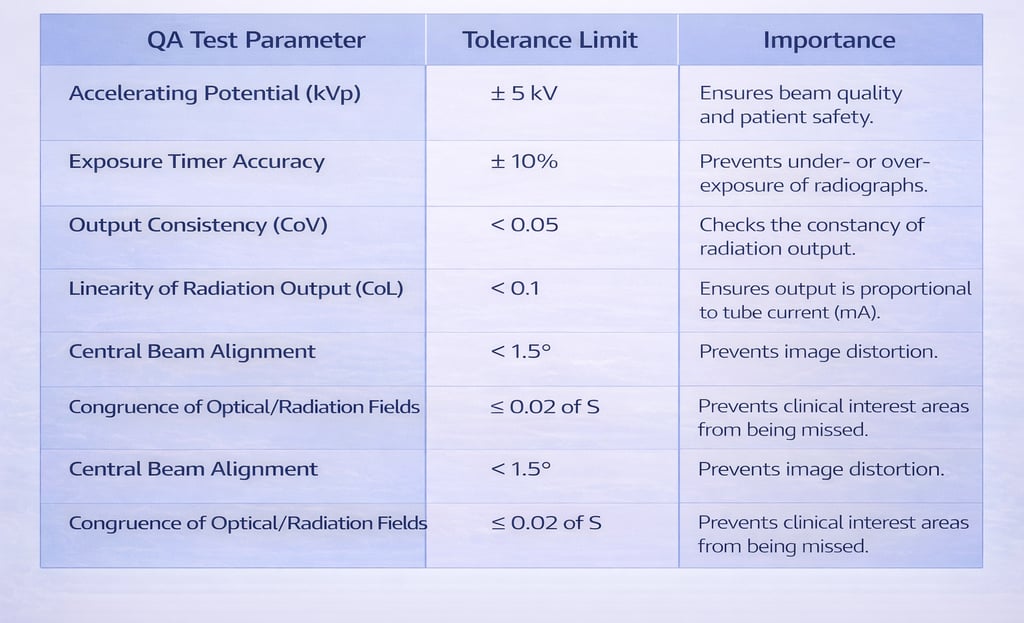
QA is a systematic action necessary to provide confidence that equipment performs satisfactorily in compliance with safety standards. The end-user is responsible for ensuring periodic QA is carried out once every two years, or after major repairs.
Occupational and Public Radiation Protection
To protect workers and the general public, AERB mandates the use of the Time-Distance-Shielding (TDS) principle.
Personnel Monitoring and PPE
All radiation workers are mandated to wear TLD (Thermoluminescent Dosimeter) badges to monitor their effective dose. These badges should be worn below the lead apron at chest level and stored in a radiation-free zone when not in use.
Mandatory safety tools include:
Lead Aprons: Minimum 0.25 mm lead equivalence.
Mobile Protective Barriers: Minimum 1.5 mm lead equivalence with a lead glass viewing window.
Shielding: X-ray room doors must have a lead lining of 1.7 mm.
Prescribed Dose Limits:
AERB has established strict annual limits to prevent deterministic and stochastic effects of radiation.
Occupational Workers: 20 mSv/year (averaged over five years) and a maximum of 30 mSv in any single year.
Apprentices/Students (16-18 years): 6 mSv/year.
Members of the Public: 1 mSv/year.
Patient Safety and Optimization
While there are no formal "dose limits" for medical patients, AERB emphasizes justification and optimization. Practitioners must be satisfied that necessary clinical information cannot be obtained through non-ionizing means (e.g., MRI or USG). For pediatric patients, the use of adult exposure protocols is strictly deemed unjustified. Female patients must be asked about potential pregnancy, and if X-rays are necessary, proper beam limitation and abdominal shielding must be utilized.
Offences and Penalties
Non-compliance with AERB guidelines is a serious offense. Any person who contravenes the provisions of the Atomic Energy (Radiation Protection) Rules, 2004, or the terms of their license is punishable under the Atomic Energy Act, 1962. Penalties may include the suspension or cancellation of the license, financial fines, and imprisonment.
Conclusion
AERB guidelines represent a rigorous framework designed to balance the clinical benefits of X-ray technology with the absolute necessity of human safety. For a facility to be successful and legally compliant, procurement must be followed by diligent e-LORA registration, biennial Quality Assurance testing, and the strict implementation of personnel monitoring and ALARA-based safety protocols. By adhering to these standards, healthcare and security providers ensure the highest level of diagnostic accuracy while protecting their workers, patients, and the public.
About XRAYNEWS.NET
XRAYNEWS.NET provides updates on medical and industrial X-ray technologies, radiography insights, regulatory awareness, and imaging industry developments.
Regulatory Resources
© 2025. All rights reserved.
Video Resources
Popular Topics
Quick Links
Stay Updated with X-Ray Industry News
Subscribe to receive updates on X-ray technology developments, radiography insights, and industry news.