
Radiation Safety Principles in Medical & Industrial Environments | AERB Guide India
Learn radiation safety principles in India: ALARA, dose limits, and AERB guidelines for medical and industrial environments. Ensure compliance and safety.
AERB & REGULATORY GUIDE
4/18/20264 min read
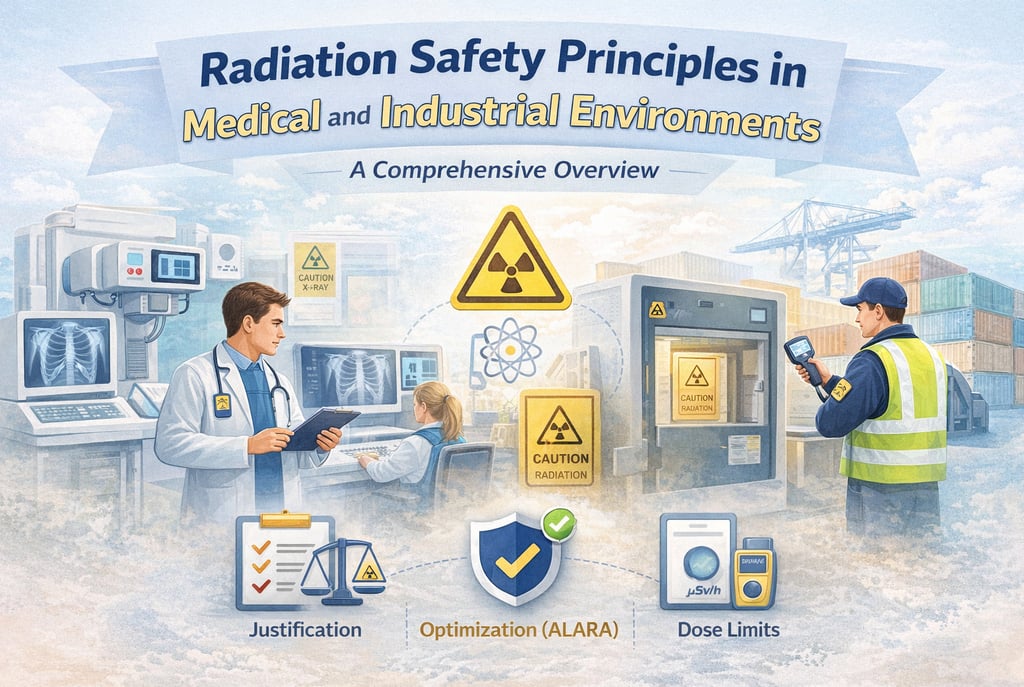
Radiation Safety Principles in Medical and Industrial Environments: A Comprehensive Overview
The use of ionizing radiation has become a foundational element of modern civilization, driving precision in medical diagnostics and efficiency in industrial analysis. From the first dental X-ray taken in 1896 by Otto Walkhoff to the high-tech AI-powered scanners of today, the goal has remained consistent: harnessing the power of radiation while minimizing its biological risks.
In India, the Atomic Energy Regulatory Board (AERB) serves as the authoritative body ensuring that the use of radiation does not cause undue risk to human health or the environment. This blog provides a detailed overview of the core principles of radiation safety—Justification, Optimization, and Dose Limits—and explores how they are implemented across medical and industrial sectors.
1. The Three Pillars of Radiation Protection
Radiation protection is built upon three internationally recognized principles defined by the ICRP and enforced by the AERB.
A. Justification
No activity involving radiation should be performed unless it produces a net benefit that outweighs the potential harm.
Medical: A medical practitioner must be satisfied that a procedure is necessary and that the clinical information cannot be obtained through non-ionizing means like ultrasound or MRI.
Industrial: Before using X-ray generating equipment (XGE) for analysis or inspection, the employer must explore alternative options that do not involve ionizing radiation.
B. Optimization (ALARA)
Exposures must be kept As Low As Reasonably Achievable (ALARA), taking economic and social factors into account. Optimization focuses on:
Time: Minimizing the duration of radiation exposure.
Distance: Maximizing the distance from the radiation source. According to the Inverse Square Law, doubling the distance from the source reduces the dose by a factor of four.
Shielding: Using materials like lead or concrete to attenuate radiation.
C. Dose Limits
To prevent harmful effects, the AERB sets strict annual effective dose limits that must never be exceeded.
Occupational Workers: 20 mSv/year averaged over five years, with a maximum of 30 mSv in any single year.
Members of the Public: 1 mSv/year.
Pregnant Workers: Once pregnancy is declared, the embryo/foetus should not receive more than 1 mSv for the remainder of the term.
2. Radiation Safety in Medical Environments
Medical facilities utilize radiation for everything from routine chest X-rays to complex interventional surgeries. Safety is managed through "built-in" design features and operational protocols.
Technical Benchmarks for Safety
X-Ray Beam Filtration: Total filtration (inherent plus added) must be at least 2.5 mm Al equivalent for systems operating at constant potential to cut off low-energy "soft" X-rays that increase patient dose without aiding the image.
Leakage Limits: Radiation leakage from the protective tube housing must not exceed 1 mGy in one hour at 1 meter for medical radiography units.
Collimation: Every X-ray tube must have a beam-limiting device (collimator) to restrict the X-ray field to the area of clinical interest, preventing unnecessary exposure to sensitive organs like the eyes and thyroid.
Operational Protocols
Personnel Protection: Operators must always work from behind a protective barrier (wall or mobile shield) and wear lead aprons (minimum 0.25 mm lead equivalence) when operating mobile units.
Quality Assurance (QA): X-ray equipment must undergo periodic QA testing every two years to verify parameters like kVp accuracy (± 5 kV) and timer accuracy (± 10%).
Staffing: Facilities must employ qualified technologists and radiologists and designate an AERB-approved Radiological Safety Officer (RSO) to oversee safety.
3. Radiation Safety in Industrial and Inspection Settings
Industrial X-ray systems are often "self-shielded," meaning the radiation source is enclosed within a cabinet that prevents radiation from escaping into the environment.
Common Industrial Modalities
XBIS: X-ray Baggage Inspection Systems used in airports and hotels.
XRF/XRD: X-ray Fluorescence and Diffractometers used for material analysis and composition identification.
PCB Analyzers: Used to check the quality of printed circuit boards.
Non-Destructive Testing (NDT): Cabinet units used to inspect tires or castings.
Safety Interlocks and Design
Door Interlocks: The X-ray beam must not energize unless all doors, shutters, or windows are completely closed.
Fail-Safe Mechanisms: If a malfunctioning occur, the beam must de-energize automatically.
Leakage Limits: For self-shielded units, the radiation level at 10 cm from any accessible external surface must be within 1 µSv/h.
Portable Field Use: For security scanners used in open fields, an area must be cordoned off so the dose at 30 meters does not exceed 5 µSv per scan.
4. Monitoring and Dosimetry: Tracking the Invisible
Because radiation cannot be seen, felt, or smelled, monitoring instruments are the only way to track occupational exposure.
Personnel Monitoring Services (PMS)
All radiation workers involved in manufacturing, testing, and servicing must use Thermoluminescent Dosimeter (TLD) badges.
Usage: In medical settings, the badge is worn below the lead apron at chest level.
Storage: After work, badges must be kept in a radiation-free zone.
Reporting: Dosimeters are exchanged quarterly for dose reporting; if a dose exceeds 15 mSv in a quarter, an investigation is triggered.
Workplace Monitoring
Facilities must maintain calibrated Radiation Survey Meters (RSM) capable of measuring dose rates from 0.1 µSv/h up to 10 mSv/h. These are used to conduct periodic radiation protection surveys and verify that shielding remains effective.
5. Roles and Responsibilities: The Compliance Chain
The AERB distributes responsibility among key stakeholders to ensure a robust safety culture.
The Employer: Holds ultimate responsibility as the custodian of the equipment. They must ensure that only AERB Type Approved equipment is procured and that no person under 18 is employed for radiation work.
The Licensee: Responsible for establishing written plans for monitoring and assessing exposure and ensuring that workers are periodically trained.
The RSO (Radiological Safety Officer): The primary technical expert who implements surveillance, conducts radiation surveys, and maintains QA records.
The Radiation Worker: Must undergo training, follow Standard Operating Procedures (SOPs), use protective devices, and monitor their own dose via TLD badges.
6. Regulatory Gateway: e-LORA and Licensing
In India, all radiation-related transactions must be handled through the e-LORA (e-Licensing of Radiation Applications) portal.
Type Approval: Manufacturers must obtain a certificate verifying their model meets national safety standards before it can be marketed.
Procurement Permission: Facilities must apply for a Procurement Letter via e-LORA before buying an X-ray unit.
Operational Licence: No X-ray equipment can be used for patient diagnosis or industrial analysis until a valid Licence for Operation is obtained, which requires the submission of an Installation Report and a QA Report.
Conclusion: Trust through Transparency and Safety
The implementation of radiation safety principles is not just a regulatory hurdle—it is a strategic commitment to Expertise, Authoritativeness, and Trustworthiness (E-E-A-T). By adhering to the ALARA principle, maintaining religious compliance with AERB Safety Codes, and fostering a culture where safety takes precedence over speed, facilities ensure the highest diagnostic quality at the lowest possible risk.
Whether in a busy hospital corridor or at a high-security airport gate, these principles remain the bedrock of radiological science, ensuring that radiation remains a safe and powerful tool for progress. Failure to comply is a punishable offense under the Atomic Energy Act, 1962, carrying penalties that include license suspension, fines, or imprisonment. Therefore, safety is not an option; it is a legal and ethical mandate.
About XRAYNEWS.NET
XRAYNEWS.NET provides updates on medical and industrial X-ray technologies, radiography insights, regulatory awareness, and imaging industry developments.
Regulatory Resources
© 2025. All rights reserved.
Video Resources
Popular Topics
Quick Links
Stay Updated with X-Ray Industry News
Subscribe to receive updates on X-ray technology developments, radiography insights, and industry news.