Regulatory Framework for X-Ray Devices in India | AERB & CDSCO Compliance Guide
Explore India’s X-ray device regulatory framework. Learn AERB, CDSCO, e-LORA processes, licensing, and compliance requirements for safe operation.
AERB & REGULATORY GUIDE
4/19/20265 min read
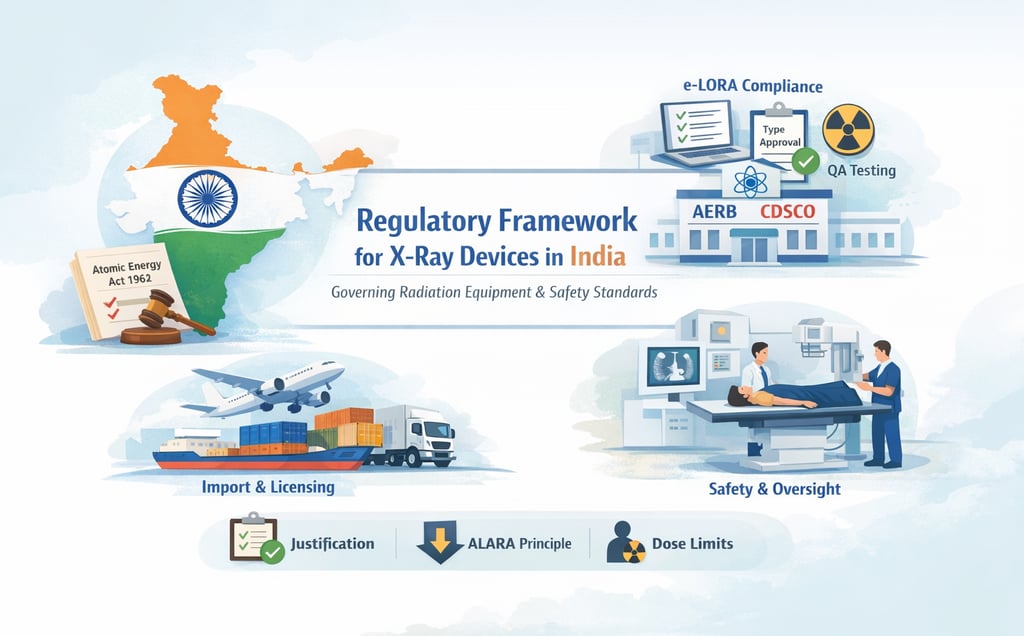
Regulatory Framework for X-Ray Devices: Overview of the Regulatory Ecosystem Governing Radiation Equipment in India
The medical use of X-rays for diagnosis and treatment has proven immensely beneficial to society, yet the unsafe use of radiation carries significant health risks. To balance these benefits against potential biological harm, India has established a rigorous and authoritative regulatory ecosystem. This framework governs the entire lifecycle of an X-ray unit—from design and manufacture to supply, installation, operation, maintenance, and final decommissioning.
This article provides a comprehensive overview of the legal, administrative, and technical benchmarks that define the Indian regulatory landscape for X-ray generating equipment (XGE).
1. The Legal Foundation: Acts and Rules
The regulation of X-ray devices in India is anchored in two primary legislative instruments that provide the legal authority for radiation safety:
The Atomic Energy Act, 1962: This parent legislation provides the basis for the control of nuclear energy and radioactive substances to ensure they are used safely and for the public good.
Atomic Energy (Radiation Protection) Rules, 2004: Promulgated under the 1962 Act, these rules provide the specific legal framework for the safe handling of radiation-generating equipment and radioactive sources.
Under these rules, the Atomic Energy Regulatory Board (AERB) is constituted as the Competent Authority responsible for laying down safety standards and enforcing regulations in India.
2. Dual Oversight: AERB and CDSCO
While the AERB oversees radiological safety, the quality and classification of X-ray machines as medical devices are managed by the Central Drugs Standard Control Organization (CDSCO).
A. Classification as "Drugs" and Class C Devices
A pivotal shift occurred on January 1, 2021, when X-ray machines were officially classified as Class C (Moderate to High Risk) medical devices under the Medical Device Rules 2017.
Mandatory Registration: All manufacturers and importers must register their X-ray machines with the CDSCO to prevent the proliferation of misbranded or inferior-quality products that lead to inaccurate results and clinical misdiagnosis.
Intended Use: The regulation defines X-ray machines as devices used to diagnose or treat patients by imaging internal structures to assess abnormalities.
B. The Mission of AERB
The primary mission of the AERB is to ensure that the use of ionizing radiation does not cause undue risk to human health or the environment. It publishes a hierarchy of regulatory documents, including Safety Codes (mandatory requirements), Safety Standards, Safety Guides, and Safety Manuals.
3. The e-LORA Portal: The Digital Gateway to Compliance
The AERB has modernized the consenting process through the e-Licensing of Radiation Applications (e-LORA) portal. All stakeholders, including hospitals, diagnostic centers, manufacturers, and suppliers, must register on this platform to conduct any regulatory transaction.
Key Administrative Steps via e-LORA:
Institute Registration: The facility registers as an "Institute" with valid credentials, identifying the Employer and Licensee.
Procurement Permission: Before purchasing equipment, the facility must obtain an AERB Procurement Letter.
Registration for Operation: Once installed, the facility must apply for a Licence for Operation.
4. Equipment Lifecycle and Consenting Process
Every model of X-ray equipment must satisfy rigorous technical checks before it reaches a patient.
A. Type Approval and NOC for Import
Prior to commercial production or marketing, every model must obtain a Type Approval Certificate.
Performance Demonstration: Approval is granted only after a prototype demonstrates satisfactory performance in a radiation testing facility.
Foreign Models: Suppliers intending to market foreign-made X-ray units must first obtain a No Objection Certificate (NOC) for import specifically for the purpose of demonstrating performance for Type Approval.
Validity: Type Approval remains valid as long as no changes are made to the design specifications of the approved model.
B. Mandatory Quality Assurance (QA)
The AERB Safety Code AERB/RF-MED/SC-3 (Rev. 2) stipulates that the end-user is responsible for periodic QA testing carried out by authorized third-party agencies once every two years or after major repairs.
5. Institutional Roles and Responsibilities
The regulatory framework distributes safety accountability among four key roles:
The Employer: Holds ultimate responsibility for radiation safety and acts as the custodian of the equipment.
The Licensee: Responsible for establishing written safety procedures, maintaining dose records, and arranging periodic QA tests.
The Radiological Safety Officer (RSO): A person approved by the Competent Authority to implement radiation surveillance, verify safety systems (like lead aprons), and advise on worker safety.
The Radiation Worker: Operators (radiographers, radiologists) are mandated to follow safe work practices and use Personnel Monitoring Services (TLD badges) to track their exposure.
6. Technical Standards and Built-in Safety
X-ray devices must meet strict design requirements to minimize stray radiation.
A. Leakage and Filtration Limits
Tube Housing Leakage: For medical radiography, leakage must not exceed 1 mGy in one hour at 1 meter from the focus. Stricter limits apply to dental IOPA units (0.25 mGy/hour) and mammography (0.02 mGy/hour).
Beam Filtration: Total filtration must be at least 2.5 mm Al equivalent for constant potential equipment to cut off low-energy "soft" X-rays that do not contribute to diagnostic images but increase patient dose.
B. Room Layout and Shielding
Facilities must provide appropriate structural shielding for walls, doors (1.7 mm lead lining), and floors. For CT and Interventional Radiology (IR), the control console must be in an adjoining room with appropriate viewing and communication facilities.
7. Core Radiation Safety Principles: ALARA and Justification
The framework is built upon three internationally recognized safety pillars:
Justification: No practice should be performed unless it produces a net benefit that outweighs potential harm.
Optimization (ALARA): Exposures must be kept As Low As Reasonably Achievable, taking economic and social factors into account.
Dose Limits: Prescribed limits that must never be exceeded.
Occupational Workers: Whole-body dose of 20 mSv per year averaged over five years.
Public Exposure: 1 mSv in a year.
8. Special Modality: Ultra-Portable (UP) X-Ray Systems
Modern advancements have led to ultra-portable and handheld X-ray systems, weighing under 12 kg, which are essential for community-based screening (e.g., Tuberculosis).
Field Safety: When lead-lined rooms are unavailable, safety is maintained by ensuring a cordoned area where the dose at 30 meters does not exceed 5 µSv per scan.
Operator Protection: Radiographers must maintain a distance of at least 2 meters and wear lead aprons (0.25 mm lead eqv).
9. Research, Education, and Industrial Equipment (XGE-REIA)
The regulatory framework extends beyond hospitals to include research and industrial units like X-ray Baggage Inspection Systems (XBIS), X-ray Diffractometers (XRD), and Printed Circuit Board (PCB) Analyzers.
Self-Shielding: Most of these units are cabinet-type (self-shielded) with leakage levels restricted to 1 µSv/h at 10 cm from the external surface.
Safety Interlocks: Cabinet doors must have fail-safe interlocks that immediately terminate X-ray emission if opened.
Conclusion: Trust through Compliance
The Indian regulatory ecosystem for X-ray devices is a sophisticated blend of legislative law, digital governance, and technical benchmarking. By adhering to the standards of the AERB and CDSCO, facilities demonstrate Expertise, Authoritativeness, and Trustworthiness (E-E-A-T). Religious compliance with biennial Quality Assurance, strict e-LORA licensing, and the appointment of qualified RSOs ensures that diagnostic medicine serves its purpose: providing the highest quality diagnostic information at the lowest possible radiation risk. Failure to comply is a punishable offense under the Atomic Energy Act, 1962, highlighting that safety is not just a best practice, but a mandatory legal requirement for protecting public health.
About XRAYNEWS.NET
XRAYNEWS.NET provides updates on medical and industrial X-ray technologies, radiography insights, regulatory awareness, and imaging industry developments.
Regulatory Resources
© 2025. All rights reserved.
Video Resources
Popular Topics
Quick Links
Stay Updated with X-Ray Industry News
Subscribe to receive updates on X-ray technology developments, radiography insights, and industry news.