
Radiological Safety Officer (RSO) in X-Ray Facilities: Complete AERB Compliance Guide
Understand the critical role of the Radiological Safety Officer (RSO) in X-ray facilities, including AERB compliance, QA responsibilities, TLD monitoring, and e-LORA management.
AERB & REGULATORY GUIDE
3/17/20265 min read
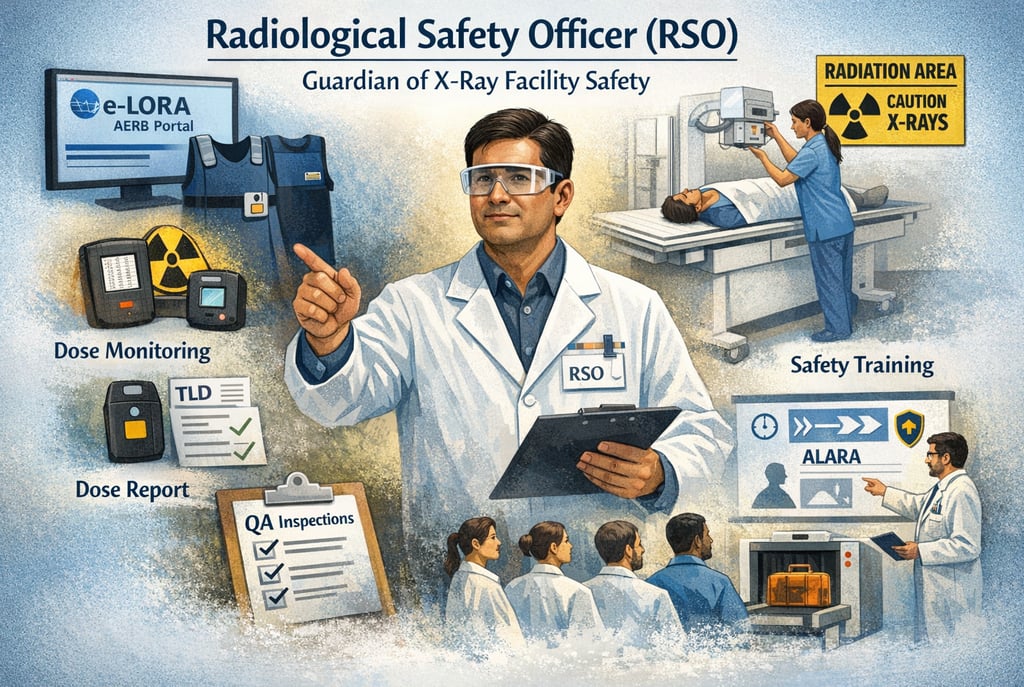
The Critical Role of the Radiological Safety Officer (RSO) in X-Ray Facilities: A Strategic Guide to AERB Compliance
In the modern landscape of diagnostic medicine and industrial inspection, the use of X-ray generating equipment (XGE) is a vital necessity for precision and analysis. However, the immense benefits of ionizing radiation come with inherent biological risks that must be strictly managed to protect workers, patients, and the public. At the heart of this safety infrastructure in India is the Radiological Safety Officer (RSO). Mandated by the Atomic Energy Regulatory Board (AERB) under the Atomic Energy (Radiation Protection) Rules, 2004, the RSO is the primary individual responsible for ensuring that a radiation facility operates within the legal and technical boundaries of safety.
This comprehensive guide explores the multifaceted role of the RSO, their qualifications, and their essential contributions to maintaining a facility's Expertise, Authoritativeness, and Trustworthiness (E-E-A-T) through rigorous compliance and a culture of safety.
1. Defining the RSO: Legal Standing and Designation
The AERB defines the RSO as any person who is so designated by the employer and who, in the opinion of the Competent Authority (the Chairman of AERB), is qualified to discharge radiation protection functions. While the Employer holds the ultimate responsibility as the custodian of the equipment, they must delegate safety oversight to an approved RSO who assists in implementing the Radiation Protection Programme (RPP).
Qualification Benchmarks
The qualifications for an RSO vary significantly based on the modality and risk profile of the facility:
Medical Facilities (CT and Interventional Radiology): The RSO must be a Radiologist, Related Medical Practitioner, or an X-ray Technologist with a degree from a recognized institution and at least three years of working experience in the field of CT/IR.
Research, Education, and Inspection (XGE-REIA): This requires a basic degree in Science or a Diploma in Engineering, combined with the successful completion of an AERB-prescribed RSO certification course.
Dental Facilities: An "Appropriate Registrant" (BDS/MDS) may be assigned the responsibilities of an RSO upon furnishing an "Undertaking" of familiarity with regulatory requirements and radiation protection aspects.
2. Core Responsibilities: The Guardian of Radiological Safety
The RSO's mission is to advise and assist the licensee and employer in ensuring compliance with national safety standards to keep exposures As Low As Reasonably Achievable (ALARA). Their duties are divided into administrative oversight and technical verification.
Advisory and Administrative Role
The RSO is responsible for advising the licensee on the necessary steps to ensure that radiation doses to workers remain well within the prescribed limits—20 mSv per year averaged over five years, and a maximum of 30 mSv in any single year. A crucial sub-role involves modifying the working conditions of pregnant radiation workers once pregnancy is declared; the RSO must ensure the embryo/foetus does not receive more than 1 mSv for the remainder of the term.
Quality Assurance (QA) and Performance Monitoring
A primary objective of the RSO is to ensure that radiology equipment yields the desired diagnostic information at the lowest possible radiation risk.
QA Periodicity: The RSO must ensure that periodic QA tests are carried out by authorized agencies at least once every two years or after major repairs.
Technical Verification: The RSO verifies critical parameters such as accelerating potential (kVp) accuracy within ± 5 kV, timer accuracy within ± 10%, and beam alignment within < 1.5°.
Protective Gear Inspection: The RSO must periodically verify the shielding adequacy of tools like lead aprons (0.25 mm lead eqv) and mobile barriers (1.5 mm lead eqv).
3. Managing Personnel Monitoring and Dosimetry
All radiation workers are mandated to use personnel monitoring services to track their effective dose. The RSO oversees the Thermoluminescent Dosimeter (TLD) badge program to ensure data integrity.
Key RSO Oversight for TLD Services:
Proper Usage: Ensuring workers wear badges correctly—typically below the lead apron at chest level.
Storage and Reporting: Managing the exchange of badges with BARC-approved laboratories every quarter for dose reporting and ensuring badges are stored in a radiation-free zone after work.
Investigation of Over-Exposures: If a worker's dose exceeds an investigation level of 15 mSv in a single monitoring period, the RSO must investigate the cause, identify failures in SOPs, and submit a report to the AERB.
4. Digital Compliance: The RSO and e-LORA
The AERB’s e-LORA (e-Licensing of Radiation Applications) portal has digitized the consenting process for all X-ray installations. The RSO is a central figure in this digital workflow.
Procurement and Licensing: The RSO often handles the technical details when applying for Procurement Letters or Licences for Operation. For example, procuring portable X-ray units requires an OTP (One-Time Password) from the RSO's registered mobile number.
Task Management: The RSO must ensure there are no "pending tasks" (such as overdue radiation checks or training records) on the facility's e-LORA account, as these can delay the approval of new procurement permissions.
Reporting: The RSO assists the licensee in submitting periodic Safety Status Reports and radiation survey records to the AERB via the portal.
5. Operational Safety and the TDS Principle
The RSO reinforces the fundamental pillars of radiation safety: Time, Distance, and Shielding (TDS).
Time: The RSO trains operators to minimize "beam-on" time and avoid unnecessary fluoroscopy runs.
Distance: For mobile and portable X-ray units, the RSO ensures that the operator maintains a distance of at least 2 meters from the source during exposure.
Shielding: The RSO ensures the operator always works from behind a protective barrier, such as a wall or a Mobile Protective Barrier (MPB). In interventional rooms, this includes ceiling-suspended lead glass and couch-hanging flaps (0.5 mm lead eqv).
Structural Oversight: The RSO verifies that X-ray room doors have a lead lining of 1.7 mm and that permanent radiation warning symbols are posted at all entrances.
6. Specialized Roles in Field and Security Applications
The rise of ultraportable handheld X-ray systems for community-based screening (e.g., Tuberculosis programs) and security has expanded the RSO's field responsibilities.
Community Safety: In field screening, the RSO ensures the area is cordoned off such that the total dose to a person at 30 meters does not exceed 5 µSv per scan.
Self-Shielded Units: For airport X-ray Baggage Inspection Systems (XBIS) or PCB analyzers, the RSO verifies that leakage levels remain below 1 µSv/h at 10 cm from the external surface.
Interlock Testing: The RSO must verify the "fail-safe" mechanisms of cabinet units, ensuring the X-ray beam de-energizes automatically if any door or panel is opened.
7. Building a Safety Culture through Training
The RSO serves as the primary educator within the facility. They are responsible for instructing workers on radiation hazards, biological effects (deterministic and stochastic), and optimal work practices. This includes:
Justification: Assisting medical practitioners in ensuring that procedures are necessary and that clinical info cannot be obtained through non-ionizing means.
Optimization: Training radiographers on appropriate exposure parameters and collimation to protect radio-sensitive organs like the thyroid, gonads, and eyes.
Paediatric Safety: Ensuring that adult exposure protocols are never used for children.
8. Consequences of Non-Compliance
Neglecting the RSO mandate or ignoring their safety directives is a serious violation of Indian law. Any person who contravenes the AERB safety code or the conditions of their license is punishable under the Atomic Energy Act, 1962. Penalties may include:
Suspension or cancellation of the Licence for Operation.
Financial fines.
Imprisonment for severe or recurring offences.
Conclusion
The Radiological Safety Officer (RSO) is the backbone of radiological protection in India, transforming regulatory mandates into practical safety. By balancing technical Quality Assurance, rigorous personnel monitoring, and digital compliance via e-LORA, they ensure that the beneficial power of X-rays is harnessed without compromising human health. For a facility to achieve true diagnostic excellence, the role of the RSO must be treated not as a bureaucratic requirement, but as a core commitment to human safety and authoritative clinical practice. In an era of evolving technology, the RSO remains the designated leader ensuring that every exposure is safe and justified.
About XRAYNNEWS.NET
XRAYNEWS.NET provides updates on medical and industrial X-ray technologies, radiography insights, regulatory awareness, and imaging industry developments.
Regulatory Resources
© 2025. All rights reserved.
Video Resources
Popular Topics
Quick Links
Stay Updated with X-Ray Industry News
Subscribe to receive updates on X-ray technology developments, radiography insights, and industry news.