
The Rise of Portable & Handheld X-Ray Systems in India: Market Trends, Technology & AERB Compliance
Explore the growing demand for portable and handheld X-ray systems in India, including technology advancements, field applications, and AERB compliance requirements.
3/18/20264 min read
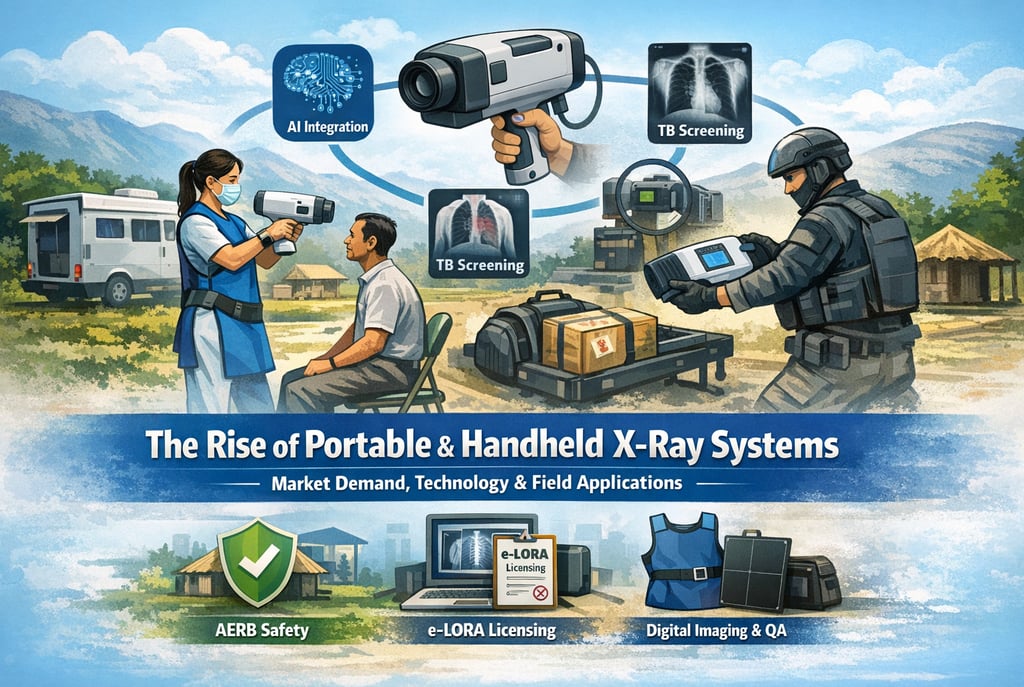
The Rise of Portable & Handheld X-Ray Systems: Market Demand, Technology, and Field Applications
The landscape of diagnostic imaging is undergoing a significant shift as the Atomic Energy Regulatory Board (AERB) and the Central Drugs Standard Control Organization (CDSCO) implement rigorous safety and quality standards across India. At the forefront of this evolution is the rise of portable and handheld X-ray systems. These "hot" products are no longer just niche tools; they have become essential for community-based screening, emergency medicine, and security. Defined by the AERB as equipment intended to be carried by one or two persons with a weight limit not exceeding 12 kg, these devices offer unprecedented clinical flexibility while adhering to the core mission of ensuring radiation safety.
Market Demand and Growth Drivers
The surge in demand for portable X-ray systems is driven by a combination of public health initiatives and the need for diagnostics in resource-limited environments.
Public Health Crises: A primary driver is the National Tuberculosis Elimination Programme (NTEP). Ultraportable (UP) systems are ideal for large-scale Chest X-ray (CXR) screening for pulmonary TB, particularly in low- and middle-income countries where expert human readers are scarce.
Infrastructure Gaps: These systems function in areas where conventional infrastructure, such as a stable power supply, is unavailable, allowing healthcare to reach remote populations.
Security and Research: Beyond medicine, there is high demand for handheld X-ray Fluorescence (XRF) devices and portable scanners in security for imaging suspicious items in the field and for non-destructive testing in industry.
User Satisfaction: Clinical simulations indicate that 97% of operators find handheld devices easier to use compared to only 50% for wall-mounted units, further driving adoption in private practice.
Technological Innovations: The Constant Potential Advantage
The technological superiority of modern portable units lies in their ability to deliver high-quality images at lower doses compared to traditional wall-mounted sources.
Generator and Waveform Efficiency Modern handheld units, such as the Nomad Pro, utilize high-frequency constant potential generators. While a traditional wall-mounted unit might operate at 70 kVp and 8 mA, a handheld unit often operates at a lower 60 kVp and 2.5 mA. The constant potential ensures that the tube operates at peak voltage for the entire exposure, eliminating the "soft" low-energy X-rays that increase patient dose without contributing to the diagnostic image.
Focal Spot Size and Resolution The ability to resolve fine anatomical details—measured in Line Pair (LP) resolution—is heavily dependent on the focal spot size.
Handheld Benchmarks: Portable units often feature a smaller focal spot size (0.4 mm) compared to fixed units (0.7 mm).
Resolution Gains: Research shows that mean LP resolution is significantly higher for handheld devices (p < 0.01), achieving better clarity for complex diagnostic tasks.
Digital Detectors and AI Integration Ultraportable systems pair battery-powered tubes with highly sensitive LG Oxide Detectors (typically 14” x 17” panels). These are increasingly integrated with Artificial Intelligence (AI) powered Computer-Aided Detection (CAD) software, which provides automated, standardized image interpretation for triaging patients.
Safety and Dosimetry: A Comparative Analysis
AERB guidelines emphasize Optimization (ALARA)—keeping exposures "As Low As Reasonably Achievable". Recent studies comparing handheld and wall-mounted dosimetry provide compelling evidence for the safety of portable systems.
Patient Dose Reduction: During a Full Mouth Examination (FMX), the mean dose for handheld units was recorded at 36 µSv, compared to 98 µSv for wall-mounted devices. This represents an effective dose reduction of approximately 12%.
Operator Exposure: When used correctly, operator exposures from handheld units are indistinguishable from ambient background levels (<2 µGy per study).
Built-in Shielding: Portable devices utilize integrated internal and external shielding to protect the operator from scatter radiation, eliminating the absolute need for heavy lead barriers in every scenario, provided the operator stands in the "safe zone".
Field Applications: From TB Screening to Forensics
The portability of these systems allows for their deployment in diverse and challenging environments.
Community Active Case Finding (ACF): UP systems are designed to fit within a suitcase or backpack, making them the "ideal tool" for community-based screening. In India, these units are deployed in ACF camps coordinated by State TB Officers (STO) and District TB Officers (DTO), with logistics support from partners like the William J. Clinton Foundation (WJCF).
Security and Industrial Inspection In the field, security personnel use portable scanners to inspect suspicious objects. AERB mandates that for these applications:
The dose per scan at a distance of 30 meters must not exceed 5 µSv.
The system must allow for remote operation from at least 30 meters away.
Forensic and Humanitarian Missions: Handheld X-rays are indispensable for forensic investigations, combat operations, and humanitarian missions where traditional fixed sources are not available. Their mobility allows for bedside imaging in emergency rooms and field hospitals.
AERB and CDSCO Regulatory Framework
In India, operating or importing X-ray equipment is a strict legal mandate governed by the Atomic Energy (Radiation Protection) Rules, 2004.
Class C Classification: As of January 1, 2021, all X-ray machines are classified as Class C (Moderate to High Risk) medical devices. This requires mandatory registration with the CDSCO to prevent the proliferation of misbranded or inferior-quality products that lead to clinical misdiagnosis.
The e-LORA Licensing Process All regulatory transactions must be handled through the e-LORA (e-Licensing of Radiation Applications) portal.
Type Approval: Manufacturers must obtain a Type Approval Certificate, verifying that the equipment conforms to national safety standards. This becomes invalid if design specifications are altered.
Procurement Permission: Facilities must obtain an AERB Procurement Letter before buying a unit. Approval typically takes only a few hours.
Licence for Operation: No unit can be used for patient diagnosis until a valid Licence for Operation is obtained, a process that usually takes about 30 days post-installation.
Operational Safety and QA Checklist
To maintain a compliant and safe facility, the Employer—the custodian of the equipment—must ensure strict adherence to operational protocols.
Radiological Safety Officer (RSO): Every facility must designate an AERB-approved RSO to oversee radiation protection and maintain dose records.
Personnel Monitoring: All workers must wear TLD (Thermoluminescent Dosimeter) badges below their lead aprons to monitor the annual effective dose limit of 20 mSv.
Protective Gear: Operators are mandated to use lead aprons (0.25 mm Pb eq) and mobile protective barriers (1.5 mm Pb eq) when operating portable units.
Biennial Quality Assurance: The end-user must ensure that Quality Assurance (QA) tests are conducted by authorized agencies once every two years to verify parameters like kVp accuracy (± 5 kV) and timer accuracy (± 10%).
Conclusion
The rise of portable and handheld X-ray systems represents a landmark shift in the accessibility of diagnostic imaging. By combining high-frequency generator technology with sensitive digital detectors and AI-powered interpretation, these systems are bridging the diagnostic gap in India’s most remote regions. However, their successful integration depends on a deep commitment to the AERB regulatory framework. Through religious e-LORA licensing, strict personnel monitoring, and biennial Quality Assurance, healthcare and security providers can harness the full potential of these devices while ensuring the absolute safety of patients, staff, and the public.
About XRAYNNEWS.NET
XRAYNEWS.NET provides updates on medical and industrial X-ray technologies, radiography insights, regulatory awareness, and imaging industry developments.
Regulatory Resources
© 2025. All rights reserved.
Video Resources
Popular Topics
Quick Links
Stay Updated with X-Ray Industry News
Subscribe to receive updates on X-ray technology developments, radiography insights, and industry news.