X-Ray Equipment Import & ADC Clearance in India: CDSCO Licensing, AERB Type Approval & e-LORA Compliance Guide
Learn the complete process for importing X-ray equipment in India, including CDSCO MD-14/MD-15 licensing, AERB Type Approval, e-LORA registration, and ADC clearance at customs.
IMPORT/EXPORT & CUSTOMS
3/16/20264 min read
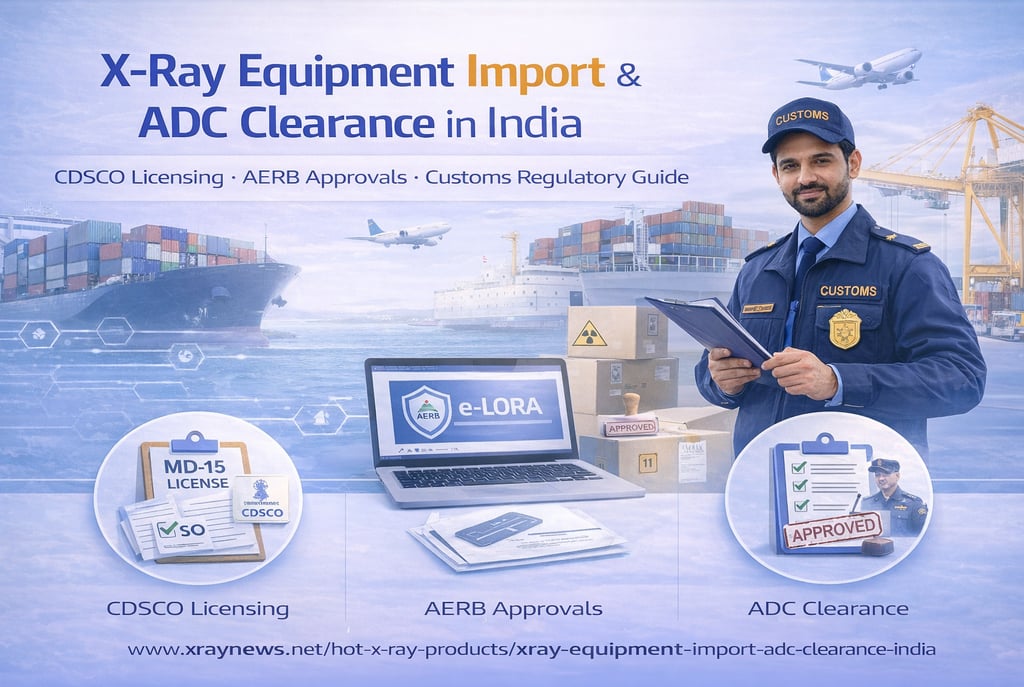
A Strategic Overview of X-Ray Equipment Import and ADC Clearance in India
The importation of X-ray generating equipment (XGE) into India is a sophisticated process governed by dual regulatory oversight to ensure both device quality and radiological safety. The government mandates that medical use of X-rays be strictly controlled throughout the equipment's life cycle—from manufacture and supply to operation and decommissioning. For importers and medical facilities, navigating the requirements of the Central Drugs Standard Control Organization (CDSCO) and the Atomic Energy Regulatory Board (AERB) is essential to secure Assistant Drug Controller (ADC) clearance and avoid significant supply chain disruptions.
The Classification of X-Ray Machines as Medical Devices
A fundamental shift in the regulatory landscape occurred when X-ray machines were classified as Class C (Moderate to High Risk) medical devices under the Medical Device Rules, 2017. This classification was established to prevent the entry of inferior quality or misbranded products that could result in clinical misdiagnosis.
Key implications of Class C classification include:
Mandatory Registration: All importers and manufacturers must register their products with the CDSCO before they can be placed on the Indian market.
Stringent Quality Standards: Imported equipment must meet high-contrast and low-contrast resolution benchmarks to ensure diagnostic efficacy.
Documentation Rigor: The application process for an import license is a meticulous exercise that requires comprehensive checklists of technical data.
CDSCO Licensing: The Pathway to MD-15
The first major hurdle for importing X-ray equipment is obtaining the necessary medical device licenses from the CDSCO. The process begins with an application for the grant of an import license, which is contingent upon a thorough review of the manufacturing site and the product's performance.
MD-14 Application: Importers must use Form MD-14 to apply for the grant of an import license for Class C medical devices.
MD-15 License: Upon successful processing and payment of fees, the Central Licensing Authority issues Form MD-15, which serves as the official Licence to Import.
Checklist Essentials: The regulatory dossier must include Manufacturing Site details, valid international certifications (like CE or ISO), and authenticated performance reports.
Errors in these filings can lead to complete delays in business plans and financial overheads.
AERB Consenting Process for Imported Equipment
In addition to CDSCO registration, every imported X-ray model must satisfy the radiological safety requirements of the AERB. The e-LORA (e-Licensing of Radiation Applications) portal is the primary digital gateway for these regulatory transactions.
A. No Objection Certificate (NOC) for Import
A supplier intending to market X-ray equipment of foreign make must first obtain an NOC for Import specifically for Type Approval from the Competent Authority. This certificate is issued only if the equipment satisfies the safety requirements of the national code and demonstrates performance that meets international standards.
B. Type Approval Certification
Type Approval is a prerequisite for commercial marketing in India. It is issued after the authorized supplier demonstrates the equipment's performance to the AERB. This certificate remains valid only as long as no design specifications are changed.
C. Routine Import and Procurement Permission
Once a model is Type Approved, routine import of subsequent units requires the supplier to obtain permission for procurement for each individual consignment from the Competent Authority. Importers must select the specific Type Approved model from the e-LORA dropdown menu during the application process.
Technical Benchmarks and Design Safety
For imported units to receive AERB and CDSCO approval, they must adhere to built-in safety design requirements. These benchmarks are critical for protecting radiation workers and the public from unnecessary exposure.
X-Ray Tube Housing Leakage: For standard radiography units, leakage must not exceed 1 mGy in one hour at 1.0 meter from the target. For dental intra-oral (IOPA) units, the limit is stricter at 0.25 mGy per hour.
Total Filtration: The beam must have a minimum total filtration of 2.5 mm Al equivalent for constant potential equipment to cut off low-energy components that increase patient dose without aiding image formation.
Collimation: All units must have a beam-limiting device with a light field indicator for accurate alignment.
Exposure Controls: Handheld or portable units must have a preset timer to terminate the beam automatically, and mobile units must have an exposure cable length of at least 2 meters.
Navigating the e-LORA Registration for Import
The e-LORA registration process is a multi-step digital workflow that ensures every device entering India is accounted for and safe for use.
Steps for Imported Equipment Registration:
Institute Registration: The medical facility registers on e-LORA, identifying the Employer and Licensee.
Application for Procurement (Import): The facility selects "Equipment manufactured in abroad" and applies for a procurement letter.
Model Selection: The applicant must identify the specific AERB Type Approved model and the authorized supplier from the AERB database.
Workload Declaration: The intended purpose (medical diagnosis) and expected workload must be declared.
Submission and Review: Upon submission, the AERB reviews the application; approval for procurement usually takes a few hours to days.
ADC Clearance and Port-Side Procedures
The final step in the import chain is the Assistant Drug Controller (ADC) clearance at the point of entry. ADC clearance is the mechanical gatekeeping process where the port authorities verify that all regulatory documents are in order.
Mandatory documentation for ADC clearance includes:
Valid CDSCO Import Licence (Form MD-15).
AERB Type Approval Certificate for the specific model.
NOC for Import or Procurement Permission for the specific consignment.
OEM Authorization: The supplier must provide valid authorization from the Original Equipment Manufacturer.
Mistakes at this stage, such as mismatched serial numbers or expired licenses, can lead to severe supply chain disruptions and unexpected financial overheads.
Post-Import Responsibilities and Commissioning
Once the equipment clears the ADC, the responsibility shifts to installation and commissioning. The authorized supplier is legally mandated to perform these functions to ensure the device is safe for patient diagnosis.
Installation Report: An engineer from the authorized supplier must install the unit and generate an installation report, which is then uploaded to e-LORA.
Acceptance Testing & QA: As part of commissioning, Quality Assurance (QA) tests must be performed by authorized agencies. These tests verify technical benchmarks like kVp accuracy (± 5 kV) and timer accuracy (± 10%).
Licence for Operation: The end-user must apply for and obtain an operational license through e-LORA before using the equipment on patients.
Training: The supplier must provide training on radiation safety and operating procedures to all associated staff.
Conclusion
Securing Import and ADC clearance for X-ray equipment in India is a rigorous but necessary process to maintain high diagnostic standards and ensure radiological safety. Success requires a deep commitment to regulatory excellence—from obtaining the MD-15 license from the CDSCO to securing Type Approval and procurement permissions from the AERB. By meticulously following the e-LORA workflow and adhering to established technical benchmarks, importers and healthcare facilities can leverage advanced global X-ray technology to enhance patient care while remaining fully compliant with Indian law. Consistency in bi-annual QA testing, religious use of personnel monitoring (TLD badges), and adherence to the ALARA principle are the hallmarks of a professional and authoritative radiation facility.
About XRAYNEWS.NET
XRAYNEWS.NET provides updates on medical and industrial X-ray technologies, radiography insights, regulatory awareness, and imaging industry developments.
Regulatory Resources
© 2025. All rights reserved.
Video Resources
Popular Topics
Quick Links
Stay Updated with X-Ray Industry News
Subscribe to receive updates on X-ray technology developments, radiography insights, and industry news.