Common Customs Issues in X-Ray Equipment Import: Complete ADC Clearance & Compliance Guide
Learn the most common customs issues in X-ray equipment import in India and how to avoid ADC delays with proper CDSCO, AERB, and e-LORA compliance.
IMPORT/EXPORT & CUSTOMS
3/17/20265 min read
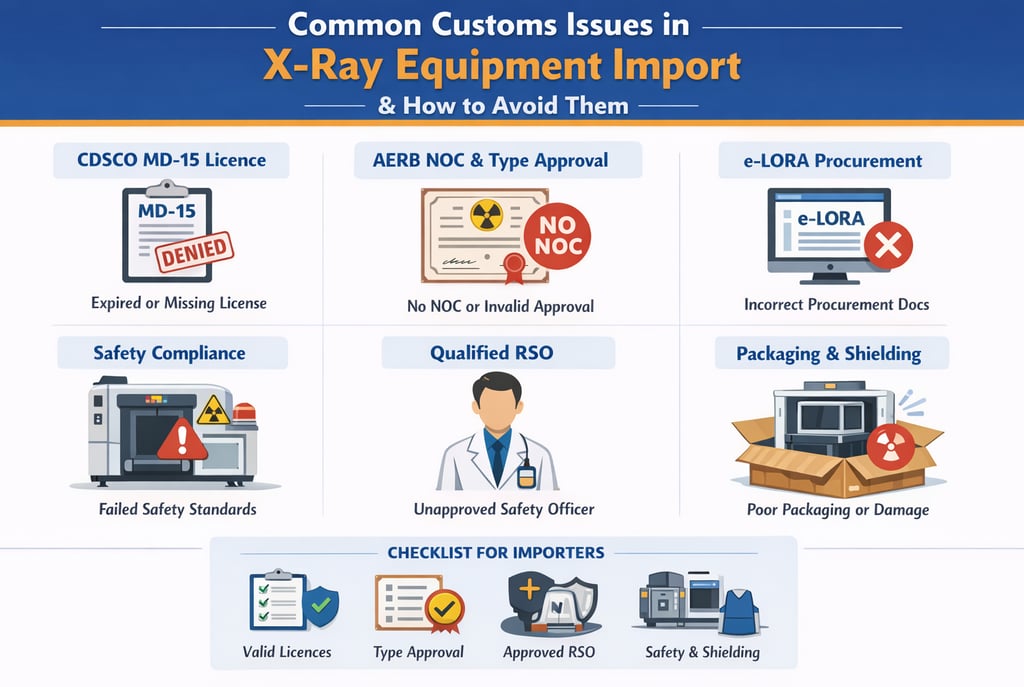
Common Customs Issues in X-Ray Equipment Import & How to Avoid Them
The diagnostic imaging and security sectors in India have transitioned into a highly regulated environment, particularly since the Central Drugs Standard Control Organization (CDSCO) reclassified X-ray machines as Class C (Moderate to High Risk) medical devices. Importing these systems now requires a dual-track regulatory compliance strategy involving both the Atomic Energy Regulatory Board (AERB) for radiological safety and the CDSCO for medical device quality. Failure to navigate this complex web of requirements often results in significant customs delays, impounded consignments, and financial overheads. This guide analyzes the most common bottlenecks encountered during Assistant Drug Controller (ADC) and customs clearance and provides actionable strategies to avoid them.
The Critical Role of the CDSCO MD-15 Import Licence
One of the primary causes of consignment stalls at the port is the absence or expiration of a valid Form MD-15. Under the Medical Device Rules, 2017, it is mandatory for all importers to register their X-ray equipment before placing the product in the Indian market to prevent the proliferation of inferior-quality or misbranded devices.
Common Issues:
Missing Manufacturing Site Registration: ADC clearance will be denied if the manufacturing plant is not duly registered with the CDSCO.
Inaccurate Fee Payments: Applications are often rejected due to incorrect fee submissions; the current schedule requires $3,000 for manufacturing plant registration and $1,500 per product.
How to Avoid Them:
Importers must apply for the grant of an import license using Form MD-14 well in advance. It is essential to conduct a meticulous review of the regulatory dossier, ensuring all international quality certifications (such as ISO or CE) are authenticated and current. Engaging dedicated regulatory advisors can help manage this time-consuming exercise and prevent business plan disruptions.
Managing AERB Type Approval and NOC for Import
Customs authorities strictly enforce the AERB Safety Code, which stipulates that no radiation-generating equipment (RGE) can be marketed or used in India unless it is Type Approved by the Competent Authority.
Common Issues:
Importing Without an NOC: Suppliers often attempt to import new foreign models without a No Objection Certificate (NOC) for Import intended for Type Approval demonstration.
Design Modifications: If any changes are made to the design specifications of an already approved model, the existing Type Approval becomes invalid, leading to immediate rejection at the point of entry.
How to Avoid Them:
Before initiating a commercial shipment of a new model, authorized suppliers must obtain an NOC from the AERB to import prototype units for performance testing. Once satisfactory performance is demonstrated, a permanent Type Approval Certificate is issued. Suppliers must ensure they only market models that strictly adhere to the validated design specifications.
Precision in e-LORA Procurement Letters
The AERB utilizes the e-LORA (e-Licensing of Radiation Applications) portal to automate the consenting process for X-ray equipment. Every individual consignment requires an equipment-specific Procurement Letter.
Common Issues:
Mismatched Model Names: Discrepancies between the model name on the shipping invoice and the one selected from the e-LORA dropdown menu can trigger a red flag during ADC inspections.
Incorrect Equipment Category: Failing to specify "Equipment manufactured in abroad" during the application process results in invalid procurement permissions.
How to Avoid Them:
The medical or industrial facility (the Employer) must register as an institute on the e-LORA server and identify the authorized supplier. When applying for the procurement letter, the exact Type Approved model must be selected from the database. The resulting document must be shared with the foreign manufacturer to ensure all commercial documentation uses identical nomenclature.
Technical Compliance with Safety Design Benchmarks
Physical inspections at customs often involve verifying the "built-in safety" features of the equipment as mandated by the AERB. Non-conformance with these technical benchmarks can lead to the decommissioning of the equipment before it even reaches the facility.
Common Issues:
Radiation Leakage Thresholds: Medical radiography units must not exceed a leakage rate of 1 mGy in one hour at 1 meter from the focus. Specialized dental intra-oral (IOPA) units have an even stricter limit of 0.25 mGy/hour.
Inadequate Cable Lengths: Mobile and portable radiography units must have an exposure cable length of at least 2 meters to ensure the operator can maintain a safe distance.
Beam Filtration Specs: Systems must provide a total filtration of at least 2.5 mm Al equivalent for equipment operating at constant potential to protect patients from unnecessary "soft" radiation.
How to Avoid Them:
Importers should require a pre-shipment Quality Assurance (QA) report from the manufacturer confirming that the specific serial numbers being shipped meet these Indian regulatory tolerances. Ensuring the X-ray tube housing is conspicuously marked with the make, model, serial number, and focal spot position is also a mandatory requirement for clearance.
Institutional Readiness and the RSO Mandate
ADC clearance and the subsequent Licence for Operation are contingent upon the facility having a qualified workforce.
Common Issues:
Unapproved RSOs: Consignments may be delayed if the institute has not designated a Radiological Safety Officer (RSO) approved by the Competent Authority.
Pending e-LORA Tasks: If the facility has overdue radiation checks or pending training notifications for existing equipment, the portal may block new procurement permissions.
How to Avoid Them:
Institutes must ensure their RSO meets the specific qualifications for their modality; for example, CT and Interventional Radiology facilities require a radiologist or technologist with at least three years of working experience. All pending tasks on the e-LORA portal must be cleared before applying for new imports to ensure a seamless approval workflow.
Logistics: Packaging, Shielding, and Safety Interlocks
For self-shielded units like X-ray Baggage Inspection Systems (XBIS) or cabinet-type NDT systems, customs officials pay close attention to safety mechanisms that prevent accidental public exposure.
Common Issues:
Malfunctioning Interlocks: Cabinets must have "fail-safe" mechanisms where the X-ray beam de-energizes immediately if any access door is opened.
Damaged Shielding: If the equipment housing is compromised during transit, it may exceed the leakage limit of 1 µSv/h at 10 cm from the external surface, resulting in a safety rejection.
How to Avoid Them:
Suppliers must use hard cases with number-coded locks for portable generators and workstation laptops to prevent unauthorized access or damage. The equipment must be transported in a sanitary environment free from dust and water leakages to preserve the integrity of the sensitive electronic detectors.
Summary Checklist for Importers
To ensure a successful ADC clearance, stakeholders should verify the following:
Valid Form MD-15 from the CDSCO for the specific product and manufacturing site.
AERB Type Approval Certificate and a corresponding e-LORA Procurement Letter.
Verification of Technical Benchmarks, including kVp accuracy (± 5 kV) and timer accuracy (± 10%).
Availability of Radiation Protection Accessories, such as lead aprons (0.25 mm lead eqv) and mobile barriers (1.5 mm lead eqv).
Official designation of an AERB-approved RSO and qualified technologists.
Conclusion
Successfully importing X-ray equipment into India requires more than just logistical proficiency; it demands a deep commitment to Expertise, Authoritativeness, and Trustworthiness (E-E-A-T) by adhering to the rigorous standards set by the AERB and CDSCO. By proactively managing e-LORA registrations, ensuring technical compliance with built-in safety benchmarks, and maintaining precise CDSCO documentation, importers and medical facilities can avoid the legal penalties of the Atomic Energy Act, 1962 and ensure their hot X-ray products are deployed safely and efficiently for public benefit.
About XRAYNNEWS.NET
XRAYNEWS.NET provides updates on medical and industrial X-ray technologies, radiography insights, regulatory awareness, and imaging industry developments.
Regulatory Resources
© 2025. All rights reserved.
Video Resources
Popular Topics
Quick Links
Stay Updated with X-Ray Industry News
Subscribe to receive updates on X-ray technology developments, radiography insights, and industry news.