
X-Ray Clinic Compliance Checklist: AERB & CDSCO Guidelines for Safe and Legal Operations in India
Complete compliance checklist for X-ray clinics in India covering AERB e-LORA licensing, CDSCO Class C registration, QA standards, radiation safety, and legal requirements.
AERB & REGULATORY GUIDE
3/16/20264 min read
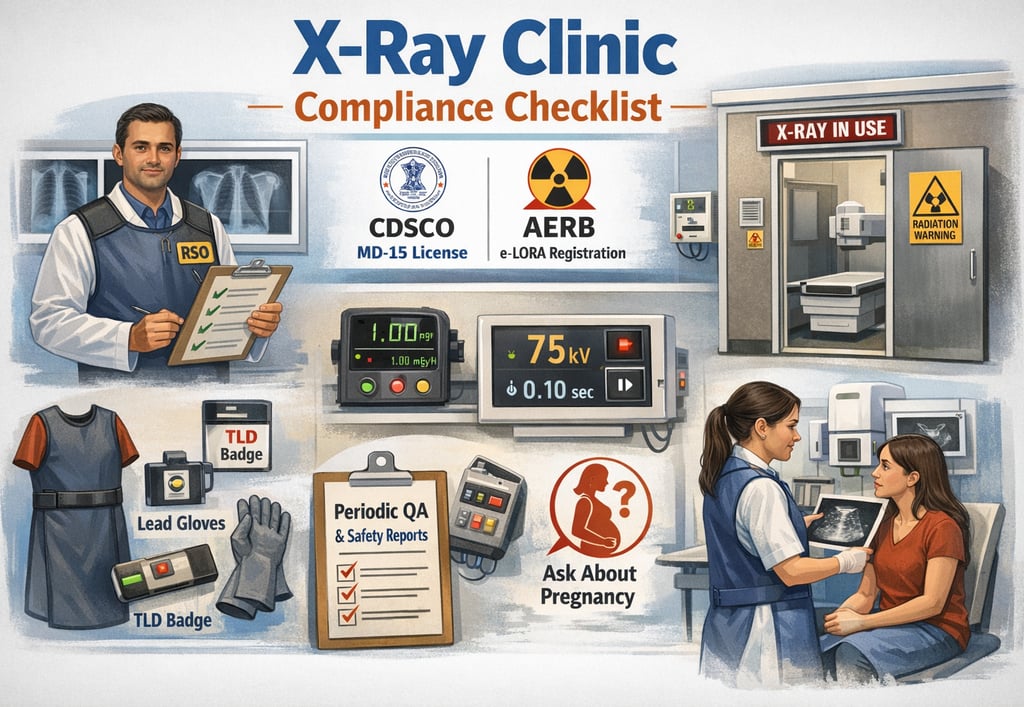
The Ultimate Compliance Checklist for X-Ray Clinics: Navigating AERB and CDSCO Regulations
In the modern diagnostic landscape, establishing a clinical X-ray facility requires more than just high-end equipment. To ensure the safety of occupational workers, patients, and the general public, the Government of India has established a rigorous legal framework under the Atomic Energy (Radiation Protection) Rules, 2004. Medical use of X-rays is immensely beneficial but carries inherent health risks that mandate proper care throughout the equipment's lifecycle—from procurement and installation to operation and eventual decommissioning. For clinic owners, maintaining an authoritative and trustworthy facility depends on strict adherence to the guidelines set by the Atomic Energy Regulatory Board (AERB) and the Central Drugs Standard Control Organization (CDSCO).
This comprehensive checklist serves as a strategic roadmap for clinics to achieve and maintain full regulatory compliance.
1. Device Registration and Import Classification
Before a single patient is imaged, the clinic must ensure that its equipment is legally recognized as a medical device under Indian law.
CDSCO Class C Classification: As of January 1, 2021, all X-ray machines are classified as Class C (Moderate to High Risk) medical devices. It is mandatory for manufacturers and importers to register these devices with the CDSCO to prevent the proliferation of misbranded or inferior products that could lead to misdiagnosis.
Import Documentation: If importing equipment, the facility must obtain an MD-15 license (Licence to Import Medical Device).
AERB Type Approval: The employer must ensure that they only procure Type Approved X-ray equipment models. Type Approval is a certificate issued by the AERB certifying that the device conforms to national safety standards.
2. The e-LORA Licensing Pathway
The e-LORA (e-Licensing of Radiation Applications) portal is the primary digital gateway for all regulatory transactions with the AERB.
Institute Registration: The clinic must register as an institute on the e-LORA server.
Procurement Permission: Clinics must apply for and obtain a Procurement Letter through e-LORA before purchasing any X-ray generating equipment.
Licence for Operation: No diagnostic X-ray equipment can be operated for patient diagnosis until a valid Licence for Operation is obtained from the Competent Authority. This license is typically valid for five years and must be renewed before expiry.
3. Facility Layout and Structural Shielding
The physical environment of the X-ray room is a critical component of "built-in safety".
Room Area and Positioning: The room housing the equipment must have an appropriate area to facilitate easy movement of staff and proper patient positioning.
Structural Attenuation: Appropriate structural shielding must be provided for walls, doors, ceilings, and floors. Specifically, all doors to the X-ray room must have a lead equivalent lining of 1.7 mm.
Specialized Rooms: For Computed Tomography (CT) and Interventional Radiology (IR), the control console must be installed in a separate room located outside but adjoining the exposure room, featuring lead glass viewing windows and oral communication facilities.
Safety Signage: A permanent radiation warning symbol and instructions for pregnant women must be prominently posted on the entrance door.
4. Mandatory Personnel and Staffing Benchmarks
A clinic cannot operate safely without qualified manpower trained in radiation protection.
Qualified Operators: The clinic must employ a radiologist, related medical practitioner, or X-ray technologist with adequate knowledge of radiation protection.
Radiological Safety Officer (RSO): Every facility must designate an AERB-approved RSO. For CT and IR facilities, the RSO must be a radiologist or a technologist with at least three years of experience in the field.
Age Prohibitions: No person under the age of 18 years can be employed as a radiation worker.
5. Radiation Protection and Safety Tools
Operators must be equipped with tools that keep exposures ALARA (As Low As Reasonably Achievable).
Personnel Monitoring (TLD Badges): All radiation workers must be provided with TLD (Thermoluminescent Dosimeter) badges to monitor dose levels. These badges must be worn below the lead apron at chest level and stored in a radiation-free zone when not in use.
Lead Equivalence Requirements:
Protective Aprons: Minimum 0.25 mm lead equivalence.
Mobile Protective Barriers (MPB): Minimum 1.5 mm lead equivalence with a viewing window.
Interventional Radiology Tools: Ceiling-suspended lead glass and couch-hanging flaps (minimum 0.5 mm lead eq) are required for IR procedures.
6. Technical Benchmarks and Quality Assurance (QA)
Systematic QA testing ensures that equipment performs satisfactorily and provides accurate diagnostic information at the lowest possible radiation risk.
QA Periodicity: The end-user is responsible for ensuring that periodic QA is conducted at least once every two years, or after major repairs.
Critical QA Tolerances:
Operating Potential (kVp): Accuracy must be within ± 5 kV.
Exposure Timer Accuracy: Error must not exceed ± 10%.
Radiation Leakage: Through the tube housing, leakage must not exceed 1 mGy in one hour at 1 meter for general radiography and 0.25 mGy/hour for dental intra-oral (IOPA) units.
Beam Alignment: Central beam alignment must be < 1.5°.
Collimation: Congruence of radiation and optical fields must be within 0.02 of S (focal spot to image receptor distance).
7. Patient Safety and Clinical Optimization
Clinics have a moral and legal duty to minimize the dose delivered to patients.
Justification: Medical practitioners must be satisfied that necessary clinical information cannot be obtained through non-ionizing means.
Pediatric Protection: Standard adult exposure protocols must never be used for children. Beam collimation must be strictly applied to the area of interest to protect the thyroid, gonads, and eyes.
Pregnancy Screening: All female patients must be asked about the possibility of pregnancy before an X-ray is performed.
Dose Recording: For high-dose procedures like CT or IR, the facility should record and provide the patient with dose related quantities (e.g., DLP or DAP).
8. Administrative Responsibilities and Ongoing Reporting
The Employer holds the ultimate responsibility for ensuring radiation safety and acting as the custodian of the equipment.
Safety Reports: The facility must submit periodic safety status reports to the AERB via e-LORA.
Incident Investigation: Any case of actual or suspected exposure in excess of regulatory limits (e.g., 20 mSv/year for workers) must be investigated by the licensee in consultation with the RSO and reported to the AERB.
Decommissioning: When equipment reaches the end of its life, it must be decommissioned by an authorized agency with prior intimation to the AERB.
Mobile Unit Restrictions: For clinics using mobile X-ray equipment, movement is strictly restricted within the institution for which it is registered.
Conclusion
Maintaining a compliant X-ray facility is an ongoing commitment to excellence and safety. By following this checklist—centered on AERB e-LORA licensing, rigorous Quality Assurance, and the TDS (Time, Distance, Shielding) principles of operational safety—clinics can ensure they provide the highest quality diagnostic information while protecting their staff and patients. Non-compliance is not only a safety risk but a legal liability; contravening the rules set by the AERB is punishable under the Atomic Energy Act, 1962, with penalties including fines, imprisonment, or the suspension of the operational license. Establishing a culture of radiation safety is the hallmark of an authoritative, E-E-A-T-focused modern medical clinic.
About XRAYNNEWS.NET
XRAYNEWS.NET provides updates on medical and industrial X-ray technologies, radiography insights, regulatory awareness, and imaging industry developments.
Regulatory Resources
© 2025. All rights reserved.
Video Resources
Popular Topics
Quick Links
Stay Updated with X-Ray Industry News
Subscribe to receive updates on X-ray technology developments, radiography insights, and industry news.