
High-Frequency vs Line-Frequency X-Ray Generators: Performance, Safety & AERB Compliance Guide
Compare high-frequency and line-frequency X-ray generators with insights on image quality, radiation dose, safety standards, and AERB compliance for modern radiology systems.
INDUSTRY INSIGHTS & TECHNOLOGY
3/17/20265 min read
High-Frequency vs. Line-Frequency X-Ray Generators: A Strategic Analysis of Performance, Safety, and AERB Compliance
The primary mission of the Atomic Energy Regulatory Board (AERB) is to ensure that the use of ionizing radiation in India does not cause undue risk to the health of people or the environment. In the realm of diagnostic radiology, this mission is fulfilled by transitioning toward technologies that prioritize the optimization of radiation protection. One of the most significant technological advancements in this field is the move from traditional line-frequency (LF) generators to modern high-frequency (HF) generators. While LF systems were once the industry standard, HF technology—characterized by its "constant potential" output—is now the benchmark for both ultraportable handheld devices and advanced fixed installations. This article provides a comprehensive technical and regulatory comparison of these systems, focusing on image quality, patient dosimetry, and mandatory safety protocols.
1. The Technological Foundation: Waveform Efficiency and Constant Potential
The fundamental difference between high-frequency and line-frequency generators lies in how they manage electrical potential during X-ray production.
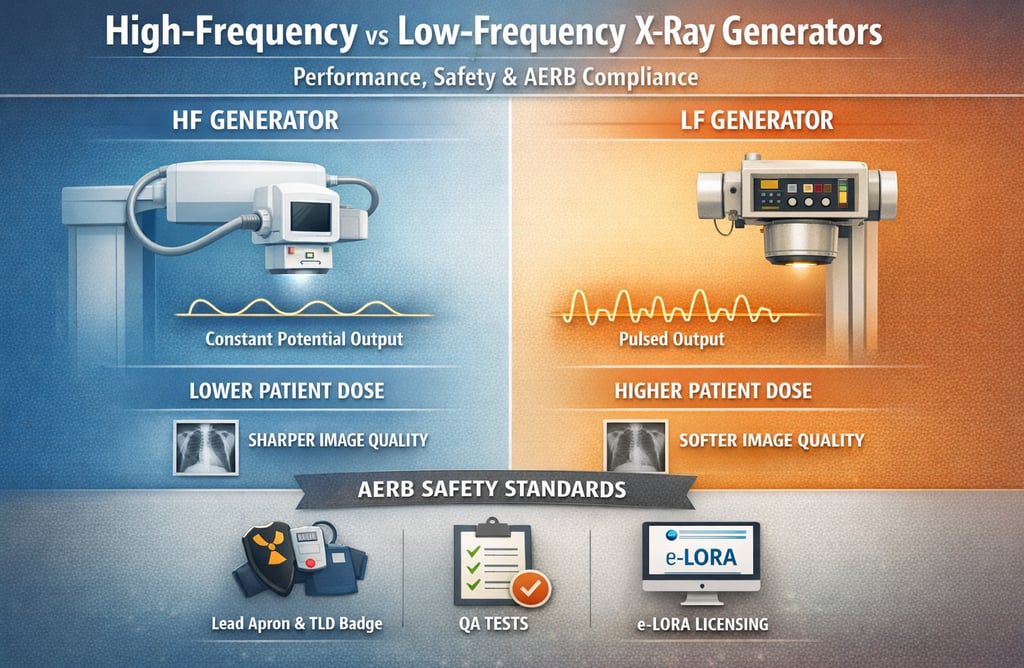
Line-Frequency (LF) Generators: Traditional LF systems (such as single-phase units) operate on standard 50 or 60 Hz power. This results in a pulsating waveform where the voltage drops to zero multiple times per second. During these troughs, the generator produces low-energy "soft" X-rays that lack the power to penetrate tissue and reach the detector. These photons do not contribute to the diagnostic image but significantly increase the patient's Entrance Skin Dose (ESD).
High-Frequency (HF) Generators: HF systems utilize sophisticated inverter technology to convert line-frequency power into high-frequency pulses (typically in the kilohertz range) before rectification and smoothing. This process creates a constant potential output.
According to the AERB Safety Code, X-ray equipment operating at constant potential must meet specific filtration requirements, such as a minimum total filtration of 2.5 mm Al equivalent. The efficiency of HF generators ensures that the X-ray tube operates at the peak voltage (kVp) for the entire duration of the exposure, drastically reducing the production of useless, low-energy radiation.
2. Image Resolution and the Impact of Focal Spot Size
Image quality is not merely a function of the digital detector; it is heavily dependent on the technical specifications of the X-ray source, particularly the effective focal spot size.
Focal Spot Benchmarks: The effective focal spot is the length and width of the spot as projected down the central ray in the X-ray field. Research comparing HF handheld devices (like the Nomad Pro) to traditional wall-mounted sources highlights a critical disparity: handheld HF units often utilize a smaller focal spot size of 0.4 mm, whereas conventional units typically feature a 0.7 mm spot.
Line Pair (LP) Resolution: A smaller focal spot results in significantly higher Line Pair (LP) resolution, allowing clinicians to resolve smaller anatomical details. Clinical simulations have demonstrated that mean LP resolution is significantly higher for HF handheld devices compared to wall-mounted sources.
The Power Trade-off: While LF wall units may offer higher operating potentials (e.g., 70 kVp and 8 mA), the stability of the HF waveform allows for optimized exposure times (as low as 0.16s) even at lower power settings (60 kVp and 2.5 mA), maintaining superior diagnostic detail without the risk of anode overheating.
3. Dosimetry: Optimizing Patient and Operator Safety
The transition to high-frequency constant potential generators is a major step in adhering to the ALARA (As Low As Reasonably Achievable) principle.
Patient Dose Reduction
The optimization of exposure factors inherent in HF technology leads to a marked reduction in radiation risk to the patient. Data indicates that:
In a Full Mouth Examination (FMX), the mean effective dose for an HF handheld unit was recorded at 36 µSv, compared to 98 µSv for a conventional wall-mounted device.
Transitioning to optimized HF protocols can result in a total effective patient dose reduction of approximately 12%.
HF systems eliminate the "soft" radiation components that increase dose without improving image quality.
Operator Protection and Safe Distances
Because HF generators are more efficient, operator exposures are often indistinguishable from ambient background levels, typically <2 µGy per study. However, safety is only maintained through the Time-Distance-Shielding (TDS) principle.
Distance: For mobile and portable units, the exposure cable length must not be less than 2 meters.
Scatter Management: The highest scatter dose is observed in the direction back towards the X-ray tube (180°). Operators must ensure they stand in a "safe zone" or maintain adequate distance—up to 4.5 meters for high-volume chest screening—to stay below the public dose limit of 1 mSv/year.
4. Regulatory Framework and Quality Assurance (QA)
In India, X-ray generating equipment is classified as a Class C (Moderate to High Risk) medical device, requiring mandatory registration with the CDSCO and licensing through the AERB’s e-LORA portal.
Mandatory QA Benchmarks
The end-user is responsible for ensuring that periodic Quality Assurance (QA) is carried out by authorized agencies every two years. HF units must meet the following mandatory tolerances:
Accelerating Potential (kVp): Accuracy must be within ± 5 kV of the set value.
Exposure Timer Accuracy: The error must not exceed ± 10%.
Output Consistency: The Coefficient of Variation (CoV) for radiation output must be < 0.05.
Linearity of Radiation Output: The Coefficient of Linearity (CoL) must be < 0.1.
Personnel Monitoring
All radiation workers are mandated to use Personnel Monitoring Services, primarily TLD (Thermoluminescent Dosimeter) badges.
Proper Use: Badges must be worn below the lead apron at the chest level.
Storage: After work, badges must be kept outside the X-ray room in a radiation-free zone.
Dose Limits: The annual effective dose for occupational workers must not exceed 20 mSv (averaged over five years) or 30 mSv in any single year.
5. Operational Responsibilities and Field Utility
HF technology has enabled the development of ultraportable (UP) and handheld systems that are ideal for community-based screening, such as Tuberculosis (TB) programs.
Portability: Portable units are defined as those weighing under 12 kg and intended to be carried by one or two persons.
Field Safety: When using these units in the community, the facility must ensure a secure storage area with a sanitary environment, free from dust and water leakages.
Licensee Duties: The Licensee is responsible for establishing written procedures for controlling exposures and ensuring that workers are trained preferably by the manufacturer or supplier.
Protective Gear: It is mandatory for operators to wear lead aprons with at least 0.25 mm lead equivalence. Mobile protective barriers with a 1.5 mm lead equivalence and viewing window should be used where applicable.
Conclusion: Why High-Frequency is the Modern Standard
The comparison between high-frequency and line-frequency generators reveals that HF technology is fundamentally superior in achieving diagnostic excellence and radiological safety. By providing a constant potential output, HF systems optimize the X-ray beam, significantly reducing patient dose while delivering superior Line Pair resolution through smaller focal spots.
However, as emphasized by AERB guidelines, technology is only effective when paired with rigorous Quality Assurance, strict e-LORA licensing, and a robust culture of safety. For any modern facility, investing in HF technology represents a strategic commitment to providing the highest quality diagnostic information at the lowest possible risk to patients and staff. Compliance with national safety regulations is not just a legal requirement but the hallmark of an authoritative and trustworthy medical practice.
About XRAYNNEWS.NET
XRAYNEWS.NET provides updates on medical and industrial X-ray technologies, radiography insights, regulatory awareness, and imaging industry developments.
Regulatory Resources
© 2025. All rights reserved.
Video Resources
Popular Topics
Quick Links
Stay Updated with X-Ray Industry News
Subscribe to receive updates on X-ray technology developments, radiography insights, and industry news.