
The Importance of X-Ray Equipment Calibration: Ensuring Safety, Accuracy & AERB Compliance
Learn why regular X-ray equipment calibration is essential for safety and diagnostic accuracy. Explore AERB and CDSCO compliance, QA testing, ALARA principles, and how proper calibration prevents misdiagnosis while ensuring optimal radiology performance.
MEDICAL X-RAY UPDATES
4/25/20264 min read
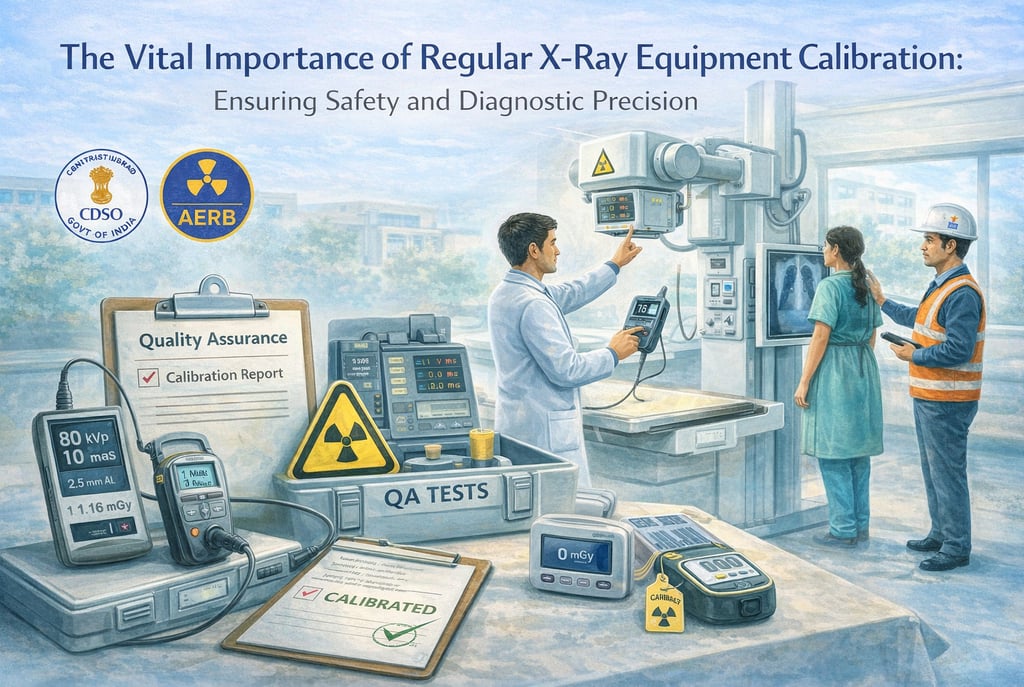
The Vital Importance of Regular X-Ray Equipment Calibration: Ensuring Safety and Diagnostic Precision
In the highly regulated environment of Indian healthcare, the Atomic Energy Regulatory Board (AERB) and the Central Drugs Standard Control Organization (CDSCO) have established a rigorous framework to ensure that medical imaging serves its primary purpose: obtaining optimum quality diagnostic information at the lowest possible radiation risk. Central to this mission is the process of Quality Assurance (QA) and regular equipment calibration. Because X-ray machines are now classified as Class C (Moderate to High Risk) medical devices, maintaining their functional performance is not only a clinical best practice but a legal mandate.
1. Defining Calibration and Quality Assurance (QA)
Calibration in diagnostic radiology refers to the systematic actions taken to verify that an X-ray unit's exposure parameters—such as tube voltage (kVp), current (mA), and time—are delivering the exact radiation output intended by the operator.
Confidence for End-Users: Calibration provides adequate confidence that equipment performs satisfactorily in compliance with safety standards.
The Baseline Concept: Routine tests ensure that the functional performance of the equipment remains similar to its initial baseline values recorded during installation.
Lifecycle Management: Safety requires proper care throughout the entire life cycle of the equipment, from manufacture and installation to servicing and decommissioning.
2. The Regulatory Mandate: Why Calibration is Mandatory
The CDSCO implemented mandatory registration for X-ray machines effective January 1, 2021, specifically to address a "big spurt" in misbranded products and inferior-quality devices.
Preventing Misdiagnosis: Inaccurate equipment leads to unacceptably inaccurate results, which can cause serious implications for patient treatment.
AERB Safety Code Compliance: Under the Atomic Energy (Radiation Protection) Rules, 2004, facilities must obtain a Licence for Operation, which is contingent upon demonstrating that the equipment meets national safety standards through a Quality Assurance Report.
Periodicity of Testing: AERB mandates that periodic QA tests be carried out once every two years, after major repairs, or whenever a malfunction is suspected.
3. Core Objectives of Regular Calibration
The ultimate goal of a radiology QA program is to balance two competing priorities: image quality and radiation dose.
Optimization (ALARA)
Exposures must be kept As Low As Reasonably Achievable (ALARA). Regular calibration ensures that the minimum radiation dose necessary for a diagnosis is delivered, preventing "dose creep" where patients receive unnecessary radiation due to uncalibrated generators.
Diagnostic Accuracy
High-quality diagnostic information depends on the equipment yielding predictable results. If a timer or kVp setting is inaccurate, the resulting image may be under- or over-exposed, leading to image retakes that effectively double the radiation dose to the patient.
4. Key Technical Parameters Tested During Calibration
Professional calibration involves a battery of tests to verify that every component of the radiological system is operating satisfactorily.
Accelerating Tube Potential (kVp): The peak potential affects the quality (penetrating power) of the X-ray beam. Calibration ensures the delivered kVp is within a tolerance of ± 5 kV of the set value.
Exposure Timer Accuracy: If the timer is out of order, radiographs can lose minute details. The acceptable percentage error is ± 10%.
Output Consistency and Linearity:
Linearity (CoL): Radiation output must change proportionally with changes in tube current (mA) stations; the coefficient of linearity must be < 0.1.
Consistency (CoV): When fixed parameters are used repeatedly, the radiation output must remain stable; the coefficient of variation must be < 0.05.
Effective Focal Spot Size: The ability to resolve small details depends on the focal spot. Calibration verifies that the focal spot has not degraded, which would otherwise blur the image.
5. Safety and Alignment: Protecting Patients and Staff
Calibration is not just about the internal electronics; it also concerns the physical alignment of the radiation beam.
Congruence of Fields: The radiation field must be perfectly aligned with the light (optical) field so the operator can accurately position the patient. Discrepancies must be within 2% of the focal spot-to-image receptor distance (S).
Central Beam Alignment: If the X-ray beam is not perpendicular to the image receptor, the image may be distorted, resulting in a complete loss of minute anatomical details. The tolerance for alignment is < 1.5°.
Total Filtration: Filters cut off low-energy "soft" X-rays that do not contribute to the image but increase patient dose. Calibration ensures the minimum total filtration (e.g., 2.5 mm Al) is present to maintain beam quality.
6. Specialized Requirements for Modern Modalities
As technology transitions from analog to digital, calibration protocols must adapt to new hardware.
Digital Imaging Systems (DR and CR)
Digital detectors and Computed Radiography (CR) plates must be calibrated periodically as per manufacturer recommendations to prevent artifacts and ensure the quality of patient images in the PACS (Picture Archiving and Communication System).
Ultra-Portable Handheld Systems
In community settings (e.g., TB screening), ultra-portable devices often lack Automatic Exposure Control (AEC). This places a greater burden on calibration and operator training to manually adjust parameters (kVp, mAs) based on patient size to avoid poor image quality or unnecessary exposure.
7. Institutional Roles: The RSO and e-LORA
Managing calibration is a coordinated effort led by the Radiological Safety Officer (RSO).
RSO Responsibility: The RSO is responsible for carrying out periodic QA tests and ensuring the periodic calibration of monitoring instruments.
Authorized Agencies: All QA and calibration must be performed by service agencies authorized by the AERB.
Record Keeping: Objective evidence of quality—including QA summary reports and quarterly dose reports—must be maintained and uploaded to the e-LORA (e-Licensing of Radiation Applications) portal to maintain the facility's operational license.
8. Consequences of Neglecting Calibration
Failure to maintain calibrated equipment leads to several critical failures:
Increased Population Dose: Poorly optimized units contribute to higher radiation exposure for the general public.
Clinical Misdiagnosis: Artifacts or poor contrast can hide life-threatening abnormalities, such as pulmonary Tuberculosis.
Legal Penalties: Contravention of AERB safety codes is punishable under the Atomic Energy Act, 1962, with penalties including fine, imprisonment, or suspension of the facility's license.
Conclusion: Calibration as the Foundation of Trust
Regular X-ray equipment calibration is the cornerstone of Expertise, Authoritativeness, and Trustworthiness (E-E-A-T) in diagnostic radiology. By ensuring that every X-ray pulse is accurate and every beam is perfectly aligned, medical facilities fulfill their primary duty of care: providing high-spec diagnostics while adhering to the ALARA principle. In an era of AI-powered diagnostics and ultra-portable systems, religious adherence to biennial Quality Assurance and strict regulatory compliance via e-LORA remains the only way to guarantee that radiation is used safely and effectively for the benefit of society.
About XRAYNEWS.NET
XRAYNEWS.NET is an independent news site for India's medical X-ray and radiology community. Edited from Chittorgarh, Rajasthan. Write to us: info@xraynews.net
Regulatory Resources
© 2026 XRAYNEWS.NET. All rights reserved.
Video Resources
Popular Topics
Quick Links
Stay Updated with X-Ray Industry News
Subscribe to receive updates on X-ray technology developments, radiography insights, and industry news.