
Rising Demand for Portable X-Ray Machines in Rural & Emergency Healthcare: Market Trends & Technology Insights
Discover why portable X-ray machines are transforming rural and emergency healthcare. Explore market trends, AI-powered diagnostics, regulatory compliance (AERB & CDSCO), and how modern portable imaging is improving accessibility, reducing radiation dose, and enabling faster diagnosis in remote areas.
INDUSTRY INSIGHTS & TECHNOLOGY
4/23/20264 min read
Rising Demand for Portable X-Ray Machines in Rural & Emergency Healthcare: A Strategic Analysis
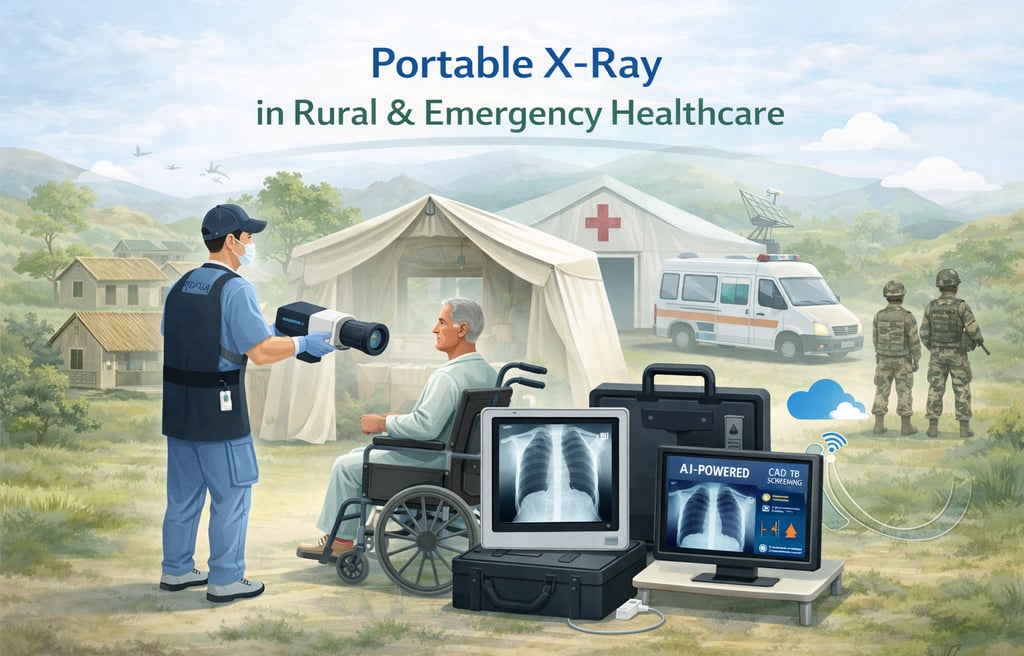
The global diagnostic imaging landscape is witnessing a transformative shift toward decentralization, driven by the critical need to bring high-quality healthcare to underserved populations. In India, the Atomic Energy Regulatory Board (AERB) and the Central Drugs Standard Control Organization (CDSCO) have established a rigorous framework to govern this evolution, ensuring that the surge in demand for portable technology does not compromise human safety. Portable X-ray systems, once reserved for niche military or forensic applications, are now at the forefront of rural public health initiatives and emergency medical services.
This article explores the market drivers, technological benchmarks, and regulatory requirements defining the rise of portable X-ray systems in India.
1. Defining Portability in the Modern Era
To understand the rising demand, one must first define the technical scope of the equipment. The AERB distinguishes between various modalities of mobile imaging:
Mobile X-ray Equipment: Systems designed to be moved on their own wheels or equivalent support within an institution.
Portable X-ray Equipment: Units intended to be hand-carried by one or two persons between locations. Crucially, the AERB mandates that the weight of such equipment shall not exceed 12 kg.
Ultra-Portable (UP) Systems: These are advanced systems designed to fit within a suitcase or backpack, often composed of a battery-powered X-ray tube and a dose-efficient digital detector.
2. Market Drivers: Why Rural Healthcare is Going Portable
The demand for portable systems in rural and resource-limited settings is driven by three primary factors: infrastructure gaps, disease screening mandates, and user satisfaction.
A. Overcoming Infrastructure Barriers
In many low- and middle-income countries (LMIC), conventional X-ray infrastructure is hampered by an unstable power supply or the complete lack of dedicated radiation-shielded rooms. Portable units function independently of the grid using rechargeable batteries, making them the "ideal tool" for community-based settings.
B. The National Tuberculosis Elimination Programme (NTEP)
A significant catalyst for demand is the systematic screening for pulmonary TB. UP systems paired with Artificial Intelligence (AI) and Computer-Aided Detection (CAD) software allow for automated interpretation of Chest X-rays (CXR). This is vital in rural areas where expert human readers are scarce.
C. Clinical Versatility and Satisfaction
Research indicates high satisfaction levels among operators using portable devices. In clinical simulations, 97% of operators were satisfied with the ease of use of handheld devices, compared to only 50% for traditional wall-mounted units. Furthermore, 87% of clinicians reported they would recommend these systems to colleagues.
3. The Technological Edge: Portable vs. Conventional Systems
The move toward portability is not just about size; it is about superior imaging physics and dose optimization.
Generator Efficiency: Modern portable units typically utilize high-frequency constant potential generators (e.g., 60 kVp), which ensure the tube operates at peak voltage for the entire exposure, eliminating "soft" low-energy radiation that increases patient dose without aiding the image.
Focal Spot and Resolution: Portable systems often feature a smaller focal spot (0.4 mm) compared to conventional fixed units (0.7 mm). This leads to significantly higher Line Pair (LP) resolution, allowing for the visualization of finer anatomical details.
Dose Reduction: Simulations of Full Mouth Examinations (FMX) show that handheld units can reduce patient effective dose to 36 µSv, compared to 98 µSv for wall-mounted devices—an effective dose reduction of approximately 12% due to optimized exposure factors.
4. Radiation Safety and the ALARA Principle
Every radiation installation must adhere to the ALARA (As Low As Reasonably Achievable) principle. In rural and emergency field operations, safety is maintained through the TDS (Time, Distance, Shielding) principle.
A. Operator and Public Protection
Distance: For mobile and portable units, the operator is mandated to maintain a distance of at least 2 meters from the source during activation.
Shielding: Operators must always wear protective lead aprons (minimum 0.25 mm lead equivalence).
Field Safety: When using portable scanners in open areas, the facility must ensure a cordoned-off zone where the dose at the boundary (30 meters from the generator) does not exceed 5 µSv per scan.
B. Personnel Monitoring
All radiation workers must use Thermoluminescent Dosimeter (TLD) badges to track their occupational dose. These badges must be worn below the lead apron at chest level and exchanged quarterly for dose reporting.
5. Regulatory Framework: CDSCO and AERB Compliance
Navigating the Indian regulatory ecosystem is a legal prerequisite for any facility using portable X-ray technology.
CDSCO Classification: Since January 1, 2021, X-ray machines have been classified as Class C (Moderate to High Risk) medical devices. This requires mandatory registration to prevent the use of misbranded or inferior products that could lead to misdiagnosis.
AERB Type Approval: No model can be marketed unless it has a Type Approval Certificate, which verifies the device conforms to national safety standards.
The e-LORA Gateway: All stakeholders must use the e-Licensing of Radiation Applications (e-LORA) portal for procurement permissions and operational licenses.
6. Operational Best Practices in Rural Environments
To maintain Expertise, Authoritativeness, and Trustworthiness (E-E-A-T), facilities must follow standardized operational protocols.
Key Stakeholder Roles
State TB Officer (STO) & District TB Officer (DTO): Coordinate site identification, delivery, and licensing.
Radiological Safety Officer (RSO): A qualified professional (e.g., a radiologist or trained technologist) approved by AERB to oversee safety.
Facility In-Charge: Acts as the custodian, ensuring safe storage in a sanitary environment free from dust and moisture.
Maintenance and Quality Assurance (QA)
Biennial QA: The end-user is responsible for ensuring that periodic QA is carried out by authorized agencies once every two years.
QA Parameters: Key checks include kVp accuracy (within ± 5 kV) and timer accuracy (error ≤ ± 10%).
Logbook Maintenance: Operators must maintain a logbook recording the daily use and storage of the equipment.
7. Emergency and Specialized Field Applications
The utility of handheld and portable units extends beyond routine clinics:
Combat and Forensic Operations: Used in environments where traditional fixed sources are unavailable.
Humanitarian Missions: Providing bedside imaging in temporary field hospitals.
Active Case Finding (ACF): Conducting mobile camps to reach vulnerable groups through door-to-door visits.
Conclusion: The Future of Radiological Excellence
The rising demand for portable X-ray machines in rural and emergency healthcare is a testament to the power of technological miniaturization when paired with rigorous safety standards. By adhering to the AERB Safety Code and the CDSCO Medical Device Rules, India is successfully bridging the diagnostic gap while upholding the highest levels of patient and operator protection.
The integration of high-frequency generators, AI-CAD interpretation, and cloud-based PACS ensures that a patient in a remote village receives the same diagnostic accuracy as one in a metropolitan hospital. For medical facilities, success in this new era depends on a commitment to religious Quality Assurance, strict personnel monitoring, and a culture of safety centered on the ALARA principle. Failure to comply with these mandates is a punishable offense under the Atomic Energy Act, 1962, emphasizing that in the field of radiology, safety is the primary mandate for public trust and clinical excellence.
About XRAYNEWS.NET
XRAYNEWS.NET is an independent news site for India's medical X-ray and radiology community. Edited from Chittorgarh, Rajasthan. Write to us: info@xraynews.net
Regulatory Resources
© 2026 XRAYNEWS.NET. All rights reserved.
Video Resources
Popular Topics
Quick Links
Stay Updated with X-Ray Industry News
Subscribe to receive updates on X-ray technology developments, radiography insights, and industry news.