
Industrial X-Ray Detector Price in India (2026): Cost, Factors & Buying Guide
Explore industrial X-ray detector price in India (2026) with detailed insights on DR panel cost, key factors, technology, and regulatory expenses.
4/30/20263 min read
Industrial X-Ray Detector Price in India (2026 Guide): Factors, Technology, and Regulatory Costs
As India’s industrial sector expands, the demand for X-ray Generating Equipment for Research, Education, Inspection, and Analysis (XGE-REIA) has surged. These systems are critical for applications ranging from X-ray Baggage Inspection Systems (XBIS) in security to Non-destructive Testing (NDT) in manufacturing and quality control for Printed Circuit Boards (PCBs).
When budgeting for industrial X-ray equipment in 2026, stakeholders must look beyond the initial hardware quote. The true price is a composite of high-spec technology, mandatory safety engineering, and meticulous regulatory compliance with the Atomic Energy Regulatory Board (AERB) and the Central Drugs Standard Control Organization (CDSCO).
1. Core Determinants of Hardware Pricing
The cost of an industrial X-ray detector is primarily dictated by its ability to resolve detail while maintaining safety.
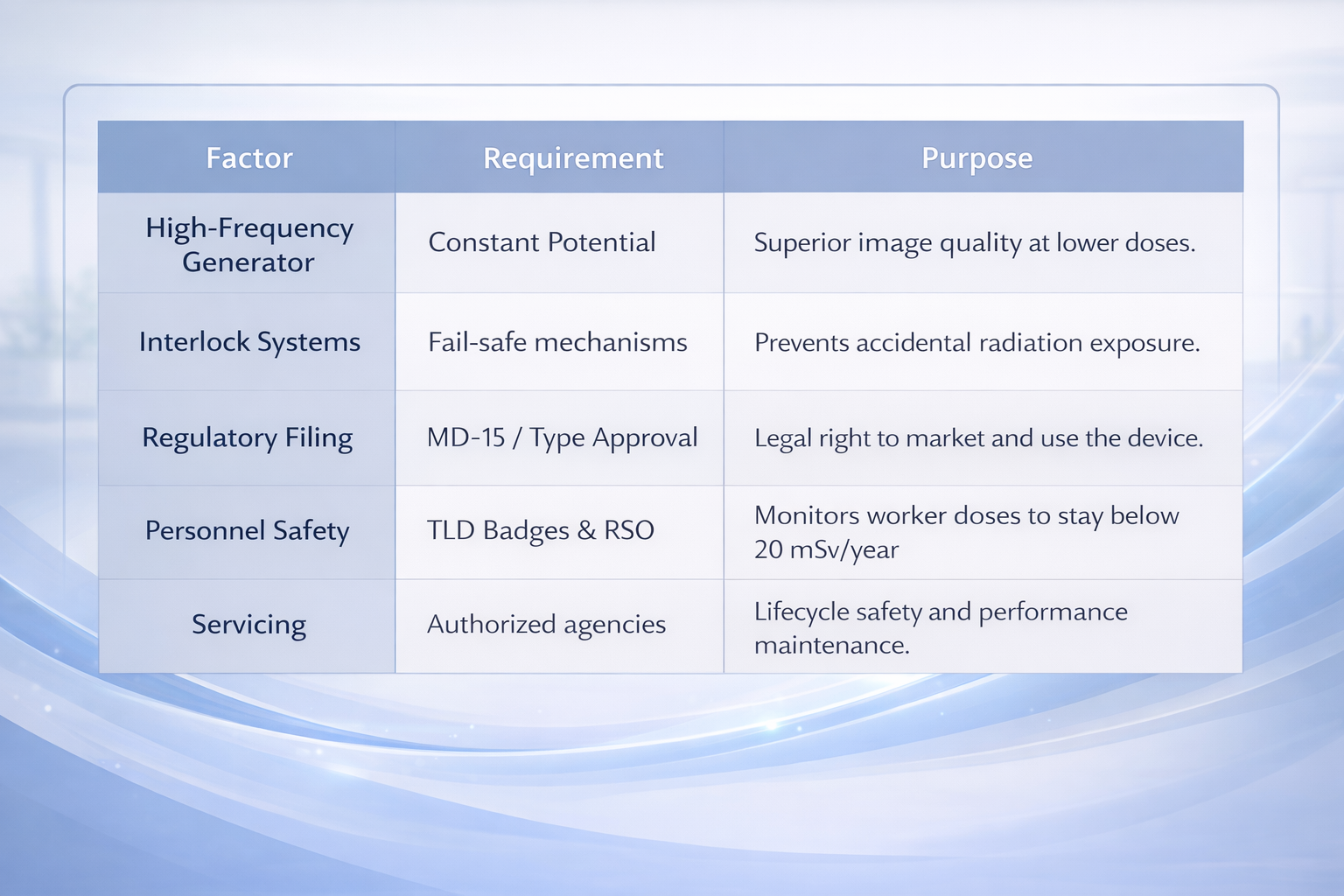
Generator Sophistication: Modern systems utilize high-frequency constant potential generators, which are more efficient than conventional low-frequency units. These generators ensure that the tube operates at peak voltage for the entire exposure, optimizing radiation quality and reducing "soft" radiation.
Focal Spot and LP Resolution: A smaller effective focal spot size (e.g., 0.4 mm vs 0.7 mm) significantly increases Line Pair (LP) resolution. Higher-priced systems typically offer resolutions in the range of 6.05–6.55 lp/mm, which is essential for identifying minute defects in PCBs or material compositions.
Detector Type: Digital Radiography (DR) has largely replaced older Computed Radiography (CR) systems. Dose-efficient LG Oxide Detectors (often sized 14” x 17”) offer near-instantaneous visualization and are standard in high-end portable and cabinet systems.
2. Modality-Specific Price Factors
The application of the X-ray unit dictates its physical design and, consequently, its price.
Self-Shielded/Cabinet Systems: Systems like XBIS, XRD (X-ray Diffractometer), and PCB Analyzers are "self-shielded," meaning the radiation source is enclosed in a cabinet. These must be designed so the beam cannot be switched "ON" unless all doors and interlocks are closed.
Portable X-ray Scanners (PXS): Used for imaging suspicious items in the field, these systems must allow for remote operation from a distance of at least 30 meters. The technical requirement to keep the dose at 30 meters within 5 µSv per scan adds to the engineering cost.
Handheld XRF Units: These devices require advanced proximity sensors to ensure they only fire when the object is at the correct distance, adding a layer of safety-critical hardware.
3. The Cost of Regulatory Compliance
In India, handling X-ray equipment is a legally protected activity. Any "handling"—which includes import, manufacture, sale, and use—requires formal consents.
CDSCO Medical Device Registration
Since January 1, 2021, all X-ray machines have been classified as Class C (Moderate to High Risk) medical devices.
Mandatory Registration: This regulation was implemented to prevent a spurt in misbranded or inferior products that lead to misdiagnosis.
Registration Fees: Importers must budget for government fees, which are approximately 3,000formanufacturingplantregistration∗∗and∗∗1,500 per product [Earlier context/286]. Indigenous manufacturers typically pay ₹50,000 for plant registration and ₹1,000 per product [Earlier context/182].
AERB Type Approval and Consenting
Type Approval: No model can be marketed without an AERB Type Approval Certificate, which verifies the unit meets national safety standards.
e-LORA Portal: All transactions—from Procurement Permission to Licence for Operation—must be managed through the e-Licensing of Radiation Applications (e-LORA) digital portal.
4. Safety Infrastructure and Operational Overheads
The facility housing the equipment must meet strict environmental and staffing benchmarks.
Shielded Enclosures: For manufacturing or heavy testing, facilities require engineered enclosures where radiation levels outside do not exceed 1 µSv/h.
The Radiological Safety Officer (RSO): Every manufacturing or heavy-use facility must have an AERB-approved RSO. The RSO ensures ALARA (As Low As Reasonably Achievable) principles are followed and maintains Quality Assurance (QA) records.
Personnel Monitoring: Workers involved in testing or servicing must use Thermoluminescent Dosimeter (TLD) badges, which are exchanged quarterly for dose reporting.
Periodic Quality Assurance (QA): All X-ray units must undergo periodic QA testing by authorized agencies once every two years.
5. Summary: What You Are Paying For
Conclusion: Prioritizing E-E-A-T in X-Ray Procurement
Investing in an industrial X-ray detector in 2026 is a commitment to Expertise, Authoritativeness, and Trustworthiness (E-E-A-T). A "good" industrial X-ray procedure is one that provides the highest quality diagnostic information at the lowest possible radiation risk.
Buyers should only source from AERB-authorized suppliers and ensure every unit is Type Approved. Failure to comply with the Atomic Energy Act, 1962 can lead to license suspension, fines, or imprisonment. By choosing high-spec hardware that integrates built-in safety with religious adherence to Quality Assurance, Indian industries ensure that radiation remains a powerful tool for progress rather than a health liability.
About XRAYNNEWS.NET
XRAYNEWS.NET provides updates on medical and industrial X-ray technologies, radiography insights, regulatory awareness, and imaging industry developments.
Regulatory Resources
© 2025. All rights reserved.
Video Resources
Popular Topics
Quick Links
Stay Updated with X-Ray Industry News
Subscribe to receive updates on X-ray technology developments, radiography insights, and industry news.