
Unlocking Precision and Safety: The Ultimate Guide to Industrial Radiography Equipment
Explore the ultimate guide to industrial radiography equipment covering precision inspection, radiation safety, NDT applications, and compliance standards for industrial testing.
4/30/20265 min read
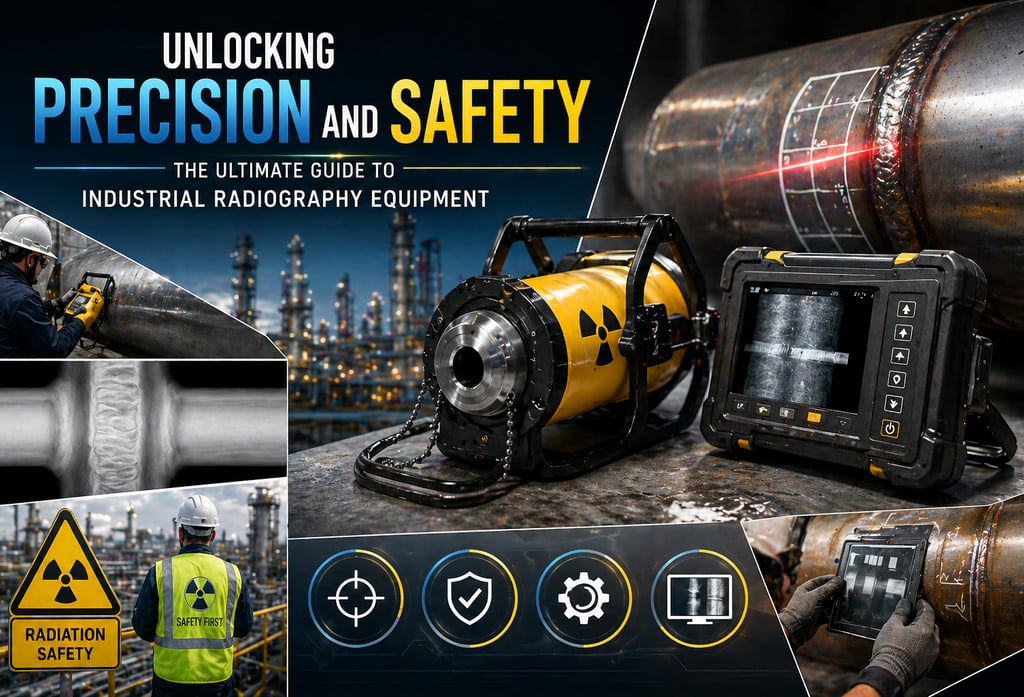
Unlocking Precision and Safety: The Ultimate Guide to Industrial Radiography Equipment
In the modern industrial world, the ability to see through solid materials without damaging them is not just a technological luxury; it is a critical safety and quality prerequisite. From checking the structural integrity of high-pressure pipelines to identifying suspicious items in airport security, Industrial Radiography Equipment is the invisible backbone of Non-Destructive Testing (NDT) and security analysis.
In India, the utilization of X-ray Generating Equipment (XGE) for research, education, inspection, and analysis (REIA) is strictly governed by the Atomic Energy Regulatory Board (AERB) and the Atomic Energy Act, 1962. This guide provides a deep dive into the types, technical benchmarks, and legal requirements for industrial radiography in 2026.
1. Categorizing Industrial Radiography Equipment
Industrial X-ray systems are categorized based on their design, mobility, and the environment in which they operate. Understanding these distinctions is the first step toward selecting the right tool for the job.
A. Self-Shielded and Cabinet-Type Units
These are the most common industrial systems, where the X-ray tube is housed within a specialized enclosure designed to provide built-in biological shielding.
X-ray Baggage Inspection Systems (XBIS): Essential for security in airports, hotels, and public venues.
PCB Analyzers: Used in the electronics industry to verify the quality and composition of printed circuit boards.
NDT Cabinets: Utilized for inspecting metal castings, tires, and other manufactured components for internal defects.
Food and Mail Scanners: Systems designed to scan packaged products for contaminants or quality control.
B. Portable X-Ray Scanners (PXS)
Used primarily by security and law enforcement, these units are designed for field imaging of suspicious items. The AERB defines "Portable" equipment as units intended to be hand-carried by one or two persons, weighing not more than 12 kg.
C. Handheld Devices (XRF and XRD)
X-ray Fluorescence (XRF) and X-ray Diffractometer (XRD) devices are used for material analysis and identifying composition. Handheld XRF units are prized for their portability but require specific safety interlocks and proximity sensors to prevent accidental exposure.
2. Technical Excellence: Measuring Performance and Resolution
The "Expertise" of an industrial radiography system is measured by its ability to provide the optimum quality diagnostic information at the lowest possible radiation risk.
A. Spatial Resolution (The Detail Benchmark)
Spatial or high-contrast resolution is the system's ability to visualize small structural details.
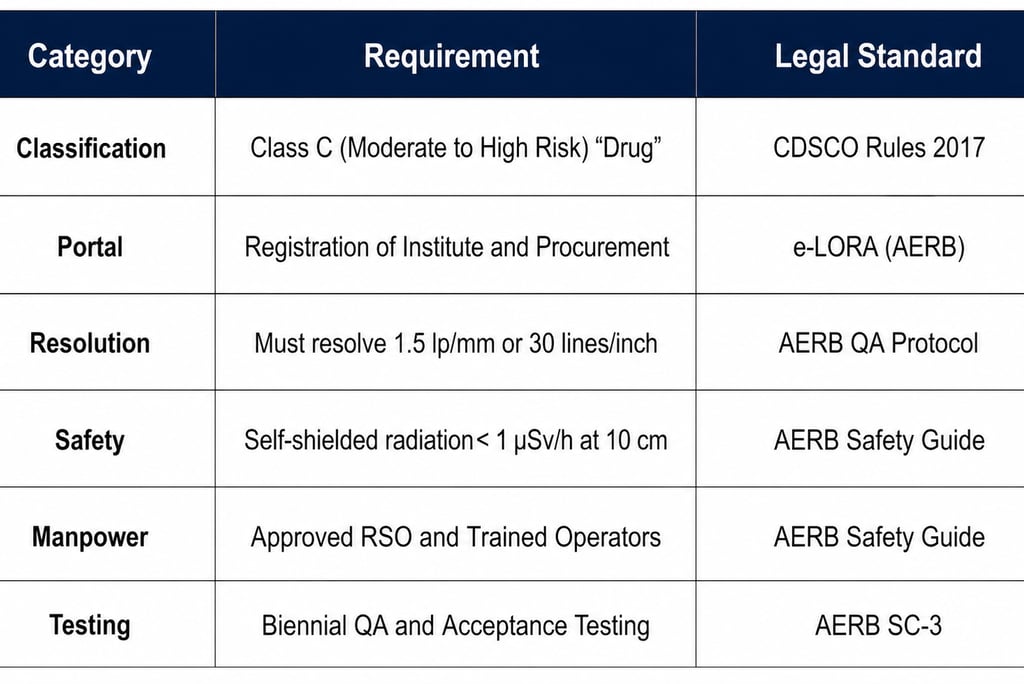
The Mandate: For an industrial imaging system to be authoritative, it must resolve a mesh pattern of 30 lines/inch or a bar pattern of 1.5 lp/mm.
Focal Spot Impact: The resolving power depends entirely on the effective focal spot size. Systems using smaller spots (e.g., 0.4 mm) achieve significantly higher resolution than traditional units with 0.7 mm spots.
B. Accelerating Potential (kVp) and Stability
The peak potential (kVp) determines the penetrating power of the beam.
Accuracy: The delivered kVp must remain within a tolerance of ± 5 kV of the set value to ensure consistent contrast and inspection quality.
Output Consistency: To ensure repeatable results, the Coefficient of Variation (CoV) for radiation output must be less than 0.05.
3. The Indian Regulatory Landscape: AERB and CDSCO
Operating industrial radiography equipment in India is a legally protected activity. Since January 1, 2021, X-ray machines have been reclassified as Class C (Moderate to High Risk) medical devices for regulatory purposes, though industrial units follow specialized safety guides (AERB/RF/SG/XGE).
A. The Reclassification Shift
X-ray equipment is now legally considered a "drug" under Notification 648(E). This transition aims to eliminate the "big spurt" of misbranded or inferior products that could lead to unacceptably inaccurate results or safety hazards.
B. The e-LORA Gateway
The e-Licensing of Radiation Applications (e-LORA) portal is the mandatory digital interface for all AERB transactions.
Procurement Permission: Employers must obtain a Procurement Letter before purchasing or importing any device.
Type Approval: Only AERB Type Approved models can be legally marketed in India. Type Approval becomes invalid if any change is made to the design specifications.
4. "Safety by Design": Protection Protocols
Radiation safety is achieved through a combination of built-in safety features and operational discipline based on the Time-Distance-Shielding (TDS) principle.
A. Built-in Safety Interlocks
Modern industrial units must feature multi-layered interlocks:
Door Interlocks: In cabinet systems, the X-ray beam must switch "OFF" automatically if a door or access panel is opened.
Fail-Safe Mechanisms: The system must automatically de-energize in the event of a malfunction and require a manual reset.
Proximity Sensors: Essential for handheld units, ensuring the beam only energizes when an object is detected at the correct distance.
B. Leakage Radiation Limits
The X-ray tube housing is engineered to limit radiation levels outside the useful beam.
Self-Shielded Limits: Radiation at 10 cm from any accessible external surface must not exceed 1 µSv/h.
Radiography Limits: General leakage through the tube housing must not exceed 1 mGy in one hour at 1 meter from the focus.
C. Field Safety for Portable Scanners
When using portable scanners in open field conditions, safety is maintained through distance:
A boundary must be cordoned off so that the dose to any person at 30 meters does not exceed 5 µSv per scan.
Devices must allow for remote operation from at least 30 meters away.
5. Roles and Responsibilities in the Lifecycle
Safety is a shared responsibility among the Employer, the Radiological Safety Officer (RSO), and the Operator.
The Employer (Licensee): Holds ultimate responsibility for radiation safety and is the custodian of the equipment.
The Radiological Safety Officer (RSO): A qualified professional approved by the AERB to oversee the Radiation Protection Programme (RPP) and ensure periodic Quality Assurance.
The Operator: Must be at least 18 years old, formally trained by the manufacturer, and familiar with standard operating procedures (SOP).
6. Maintaining Performance: Quality Assurance (QA)
A "good" procedure provides high-quality information at the lowest possible risk. Maintaining this requires religious adherence to periodic Quality Assurance.
Frequency: QA tests must be carried out once every two years, after major repairs, or when a malfunction is suspected.
Servicing: Only personnel trained and certified by the Original Equipment Manufacturer (OEM) should perform maintenance.
Record Keeping: Facilities must maintain a logbook of device operation and keep all QA and dose records for regulatory review.
7. Essential Safety Accessories and Monitoring
Even with self-shielded units, personnel involved in testing or servicing must use specialized tools.
Personnel Monitoring (TLD Badges): Workers involved in manufacturing or repair are required to use Thermoluminescent Dosimeter (TLD) badges to track their quarterly dose.
Lead Equivalence Benchmarks: When shielding is required, accessories must meet these standards:
Lead Aprons: Minimum 0.25 mm Lead Eqv.
Mobile Protective Barriers: Minimum 1.5 mm Lead Eqv.
Lead Glass Windows: Minimum 2.0 mm Lead Eqv.
Summary Checklist for Industrial Radiography Excellence
Conclusion: Trust through Total Compliance
The utilization of industrial radiography equipment in 2026 is a masterclass in balancing powerful diagnostic capabilities with uncompromising safety standards. By selecting Type Approved units, maintaining religious biennial QA, and empowering an approved RSO, industrial facilities build the Expertise, Authoritativeness, and Trustworthiness (E-E-A-T) necessary for success.
Failure to comply with these national codes is a punishable offense under the Atomic Energy Act, 1962, which can lead to the suspension of licenses, fines, or imprisonment. In the high-stakes world of industrial inspection and security, compliance is not just a hurdle—it is the foundation of a safe and reliable operation.
About XRAYNNEWS.NET
XRAYNEWS.NET provides updates on medical and industrial X-ray technologies, radiography insights, regulatory awareness, and imaging industry developments.
Regulatory Resources
© 2025. All rights reserved.
Video Resources
Popular Topics
Quick Links
Stay Updated with X-Ray Industry News
Subscribe to receive updates on X-ray technology developments, radiography insights, and industry news.