Security & Baggage X-Ray Inspection Systems: Technology, Safety Standards, QA Benchmarks & AERB Compliance Guide
Security and baggage X-ray inspection systems are essential for airports, hotels, and government facilities. Learn system types, safety benchmarks, QA standards, and AERB regulatory compliance requirements in India.
3/13/20264 min read
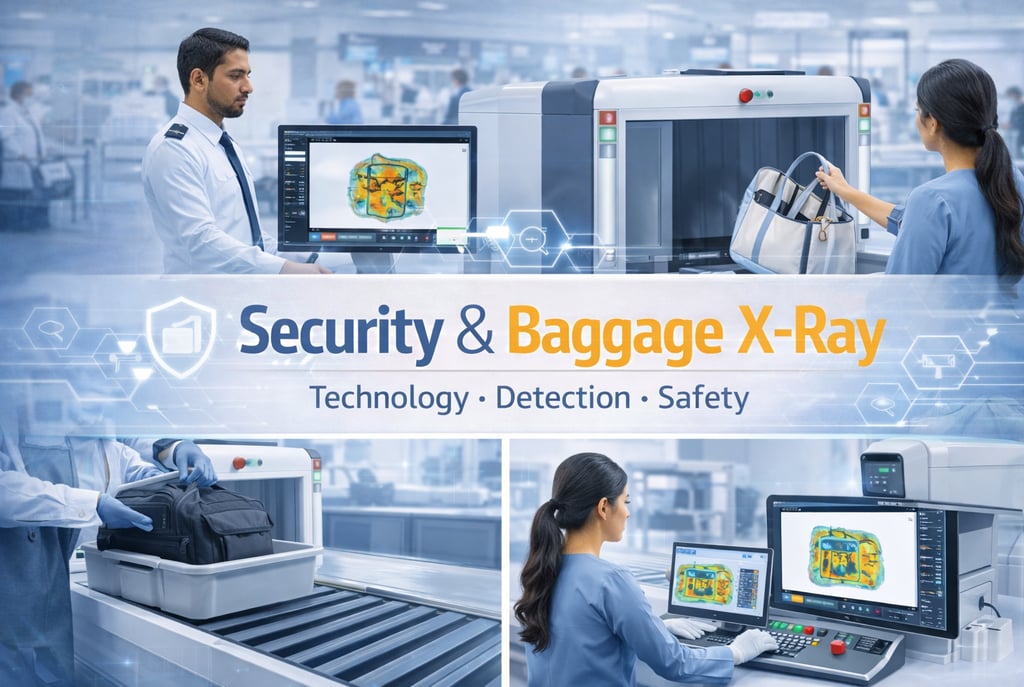
The Definitive Guide to Security and Baggage X-Ray Inspection Systems: Technical Benchmarks and AERB Compliance
In an era of heightened global security, X-ray generating equipment (XGE) has become the first line of defense at airports, hotels, government buildings, and industrial facilities. These systems, ranging from massive X-ray Baggage Inspection Systems (XBIS) to ultra-mobile portable scanners, provide non-destructive imaging of packages and cargo to identify threats. For xraynews readers, staying abreast of the Atomic Energy Regulatory Board (AERB) guidelines is essential to ensuring that these "hot" security products are operated safely and legally within India.
Types and Functionality of Security X-Ray Systems
Security X-ray systems are classified under the AERB Safety Guide as equipment used for inspection and analysis. They primarily operate in the kilovoltage range of 30 kV to 300 kV.
X-Ray Baggage Inspection Systems (XBIS): These are self-shielded, cabinet-type units used for high-throughput scanning of baggage. They utilize a conveyor system to move items through a tunnel where they are exposed to a fan-shaped X-ray beam.
CT-XBIS: A more advanced variant that utilizes Computed Tomography to create 3D cross-sectional images, significantly improving the detection of sophisticated threats like liquid explosives.
Portable X-Ray Scanners (PXS): Used by law enforcement and security agencies for field imaging of suspicious objects. These are often remotely operated to protect personnel.
Specialized Scanners: These include mail scanners for packages and food scanners used in the manufacturing sector for quality control and foreign object detection.
Safety Design Benchmarks and E-E-A-T Standards
To meet high Expertise, Authoritativeness, and Trustworthiness (E-E-A-T) standards, security equipment must conform to rigorous design benchmarks that prevent accidental exposure to operators and the public.
Self-Shielding and Leakage Limits
Most industrial and security X-ray units are "self-shielded," meaning they do not require lead-lined rooms. The equipment housing must ensure that radiation leakage does not exceed 1 µSv/h at a distance of 10 cm from any accessible external surface. This low intensity makes them safe for operation in crowded public environments like airport terminals.
Critical Safety Interlocks
AERB mandates multiple layers of "Fail-Safe" mechanisms:
Door and Cabinet Interlocks: The X-ray beam must automatically switch "OFF" if any cabinet door, service panel, or access window is opened.
Conveyor Sensors: For systems like XBIS, sensors must turn off the X-ray beam if items are not present on the conveyor belt for a preset duration.
Emergency Stop Switches: Readily identifiable "mushroom" buttons must be located on the control panel and the cabinet exterior to terminate the beam immediately in an emergency.
Key-Controlled Operation: Equipment must require a physical key or password to operate, and the key should only be removable when the X-rays are switched off.
Portable Scanner Specifications
Portable security scanners have unique requirements because they are used in open fields. The dose per scan must not exceed 5.0 µSv at a distance of 30 meters. Furthermore, these units must have a provision for remote operation from at least 30 meters away.
Regulatory Framework: AERB and e-LORA Licensing
Handling X-ray generating equipment for inspection in India is strictly governed by the Atomic Energy (Radiation Protection) Rules, 2004.
Licensing and Type Approval
No institution can procure or handle XGE without being authorized by the AERB. Manufacturers and suppliers must obtain Type Approval for every model, demonstrating that the design satisfies national safety standards.
Licensee Responsibility: The employer (Licensee) has the prime responsibility for safety and cannot delegate this duty.
e-LORA Portal: All regulatory transactions—from obtaining procurement permissions to applying for an operational license—must be conducted through the AERB's e-LORA portal.
Decommissioning
When a security X-ray unit is no longer in use, it cannot simply be discarded. Decommissioning must be performed by authorized agencies to ensure the X-ray tube and shielding materials (like lead) are disposed of according to environmental and safety protocols.
Staffing and Training Requirements
Operating security X-ray equipment requires trained personnel to maintain both operational effectiveness and radiological safety.
The Operator: Operators must have passed the 10th standard and received formal training from the Original Equipment Manufacturer (OEM) or a designated Radiological Safety Officer (RSO) on safe operation and troubleshooting.
The Radiological Safety Officer (RSO): Every facility manufacturing, supplying, or using cabinet-type NDT equipment must have an RSO. The RSO must have a basic degree in Science or a Diploma in Engineering and must have completed an AERB-recognized RSO certification course.
Classified Workers: In manufacturing and testing facilities where exposure risk is higher, employees must be designated as "classified workers" and informed of their status.
Quality Assurance (QA) Benchmarks
Periodic Quality Assurance is mandatory to verify that the functional performance of the security system has not degraded. The end-user must ensure QA is carried out at least once every two years.
Operational Safety and Public Protection
Security X-ray units are often located in high-traffic public areas, making public safety a priority.
The TDS Principle: Safety is optimized through Time, Distance, and Shielding. Operators should maximize their distance from the tunnel openings and minimize the time the beam is energized.
Cordoning for Field Work: When using portable scanners, an area of at least 30 meters must be cordoned off to ensure the public dose limit of 1 mSv/year is not exceeded.
Personnel Monitoring: While most security operators do not require TLD badges due to low radiation levels, those involved in manufacturing, servicing, and testing must use quarterly TLD services.
Dose Limits: The radiation exposure to the public from the operation of XGE in one week should not exceed 20 µSv.
Pros and Cons of Automated Security X-Ray Systems
Pros
High Throughput: Modern systems can scan hundreds of bags per hour without manual searching.
Advanced Detection (CAD): Integration with Computer-Aided Detection (CAD) and AI allows for the automated identification of knives, guns, and explosives.
Low Hazard Potential: Self-shielded designs mean that the risk to both staff and the public is extremely low under normal operating conditions.
Cons
Strict Regulatory Oversight: The administrative burden of e-LORA licensing and mandatory biennial QA can be significant for small facilities.
Specialized Maintenance: Repair and servicing can only be performed by OEM-trained engineers, which can lead to higher operational costs.
Human Factor: The effectiveness of the system still relies on the vigilance and training of the human operator.
Conclusion
Security and baggage X-ray systems are "hot products" because they enable safe public movement while maintaining high-security standards. However, their utility is inextricably linked to AERB compliance. Success for any facility—be it an airport or a private corporate office—requires a robust Radiation Protection Programme (RPP), strict adherence to QA benchmarks, and a commitment to ALARA-based safety that ensures public and occupational doses remain well within international limits.
About XRAYNNEWS.NET
XRAYNEWS.NET provides updates on medical and industrial X-ray technologies, radiography insights, regulatory awareness, and imaging industry developments.
Regulatory Resources
© 2025. All rights reserved.
Video Resources
Popular Topics
Quick Links
Stay Updated with X-Ray Industry News
Subscribe to receive updates on X-ray technology developments, radiography insights, and industry news.
Follow us on: