
Compliance Awareness for X-Ray Facilities | AERB & CDSCO Safety Guide India
Learn X-ray facility compliance in India with AERB, CDSCO, and e-LORA guidelines. Understand safety roles, QA testing, and operational responsibilities.
4/20/20264 min read
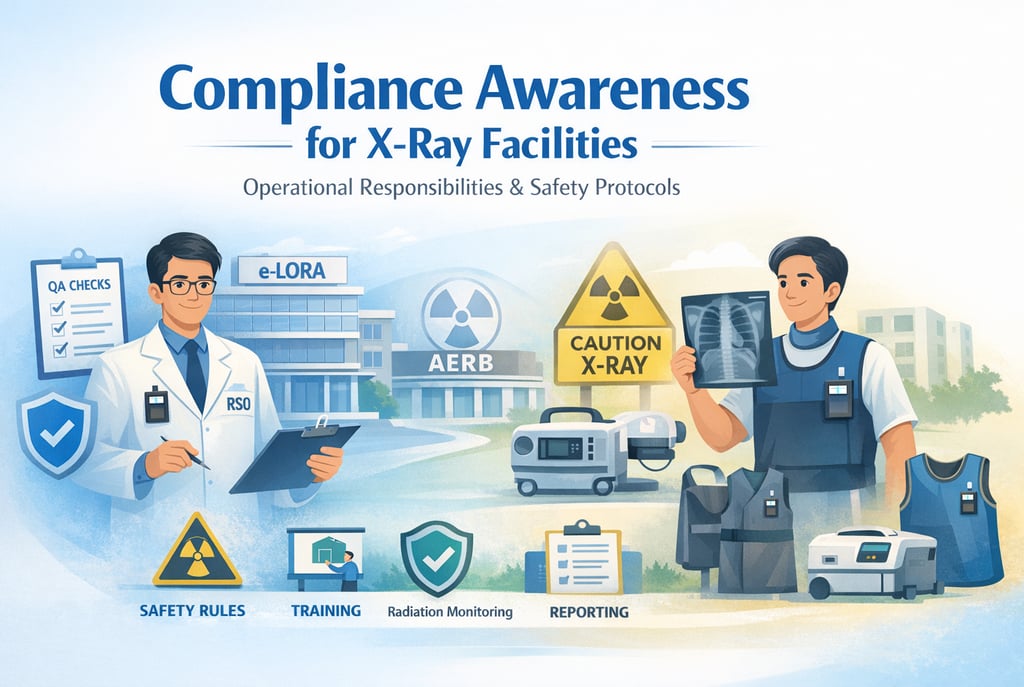
Compliance Awareness for X-Ray Facilities: A Strategic Guide to Operational Responsibilities and Safety
The fundamental objective of radiation regulation in India is to ensure that the application of ionizing radiation in medical diagnostics and industrial analysis does not cause undue risk to human health or the environment. Achieving this mission requires a sophisticated understanding of the Atomic Energy Regulatory Board (AERB) safety codes and the Central Drugs Standard Control Organization (CDSCO) quality standards. For healthcare providers and facility administrators, compliance is not merely a legal hurdle but a core commitment to Expertise, Authoritativeness, and Trustworthiness (E-E-A-T).
This article provides a high-level overview of the operational responsibilities, regulatory benchmarks, and safety protocols necessary for maintaining a compliant X-ray facility.
1. The Regulatory Landscape: A Dual-Track System
In India, X-ray facilities operate under a dual-track regulatory framework that governs both the radiological safety of the equipment and the quality of the medical device itself.
AERB Oversight: Under the Atomic Energy (Radiation Protection) Rules, 2004, the AERB is the Competent Authority responsible for enforcing radiation safety throughout the equipment's life cycle.
CDSCO Classification: Since January 1, 2021, all X-ray machines are classified as Class C (Moderate to High Risk) medical devices. This mandatory registration ensures that only high-quality, non-misbranded devices enter the market, preventing inaccurate results and misdiagnosis.
e-LORA Portal: The e-Licensing of Radiation Applications (e-LORA) system is the mandatory digital gateway for all regulatory transactions, including institute registration, procurement permission, and operational licensing.
2. Core Operational Responsibilities: The Hierarchy of Accountability
The AERB framework distributes safety responsibilities among four key roles to ensure a robust "Safety Culture".
A. The Employer (The Custodian)
The Employer holds ultimate responsibility for radiation safety and acts as the custodian of the equipment. Their duties include:
Ensuring no person under 18 years is employed for radiation work.
Designating a qualified Radiological Safety Officer (RSO) with AERB approval.
Providing mandatory radiation protection tools and monitoring services (TLD badges).
Procuring only Type Approved equipment from authorized suppliers.
B. The Licensee (The Operations Manager)
The Licensee is responsible for the day-to-day implementation of the Radiation Protection Programme (RPP). Key duties involve:
Establishing written standard operating procedures (SOPs) for controlling exposures.
Ensuring workers receive periodic training in radiation safety.
Investigating any cases of excessive exposure (>15 mSv in a monitoring period) in consultation with the RSO.
C. The Radiological Safety Officer (RSO)
The RSO is the primary technical advisor on safety aspects.
Qualifications: For CT and Interventional Radiology, the RSO must be a radiologist or a technologist with at least three years of field experience.
Key Tasks: Maintaining QA records, performing radiation protection surveys, and advising on modifications for pregnant radiation workers (who have a dose limit of 1 mSv for the remainder of the pregnancy).
D. The Radiation Worker (The Operator)
Workers must adhere to the ALARA (As Low As Reasonably Achievable) principle.
They must wear TLD badges below the lead apron at chest level during all procedures.
They are responsible for using appropriate exposure parameters and ensuring that patients are not crowded inside the X-ray room during activation.
3. Technical Benchmarks and Quality Assurance (QA)
A facility's compliance is verified through periodic Quality Assurance testing, which ensures that equipment performs within mandatory tolerances.
Mandatory QA Frequency
QA must be performed by authorized agencies at least once every two years or after any major repair/malfunction.
Key Technical Tolerances:
Operating Potential (kVp): Accuracy must be within ± 5 kV of the set value.
Exposure Timer: Percentage error must not exceed ± 10%.
Radiation Leakage: For general radiography, leakage through the tube housing must not exceed 1 mGy in one hour at 1.0 meter from the focus. Dental intra-oral (IOPA) units have a stricter limit of 0.25 mGy/hour.
Beam Alignment: The central beam must be aligned within < 1.5° to prevent image distortion.
Filtration: Total filtration must be at least 2.5 mm Al equivalent for constant potential equipment to cut off useless, low-energy "soft" X-rays.
4. Physical Infrastructure and Shielding Requirements
The layout of the X-ray room is a critical factor in protecting the public and non-radiation staff.
Shielding: Appropriate structural shielding (lead/concrete) must be provided for walls and ceilings to keep public doses below 1 mSv per year.
Doors: All entrance doors to X-ray rooms must have a lead lining of 1.7 mm.
Signage: A permanent equilateral triangle radiation warning symbol with "CAUTION X-RAY" in English, Hindi, and the local language must be posted at the entrance.
Console Placement: For CT and Interventional Radiology, the control console must be in an adjoining room with appropriate shielding and viewing facilities.
5. Specialized Field Operations: Portable and Ultraportable Units
The rise of ultraportable (UP) and handheld X-ray systems for community-based screening (e.g., Tuberculosis) has introduced unique operational challenges.
Weight Limit: Portable equipment is defined as units weighing not more than 12 kg.
Field Safety: When operating in the community, the facility must ensure a cordoned-off area where the dose at 30 meters from the generator does not exceed 5 µSv per scan.
Safe Distance: For mobile and portable units, the operator should maintain a distance of at least 2 meters from the source and wear a lead apron with at least 0.25 mm lead equivalence.
Storage: These devices must be stored in sanitary environments free from dust, water leakages, and direct sunlight.
6. Summary Checklist for Ongoing Compliance
Compliance AreaEssential ActionFrequencyLicensingRenew Licence for Operation via e-LORA.Before ExpiryQA TestingConduct Periodic Quality Assurance via authorized agency.Every 2 YearsPersonnel MonitoringExchange TLD badges and update dose records.QuarterlyProtective GearVerify shielding adequacy of lead aprons and mobile barriers.PeriodicallyReportingSubmit Periodic Safety Reports via e-LORA portal. As Specified
Conclusion: The Legal and Ethical Mandate of Safety
Operational compliance in an X-ray facility is not optional. Any person who contravenes the AERB safety code or the provisions of the Atomic Energy (Radiation Protection) Rules, 2004, is punishable under the Atomic Energy Act, 1962. Penalties can include fine, imprisonment, or the suspension of the operational license.
Ultimately, a good diagnostic X-ray procedure is one that provides the highest quality diagnostic information at the lowest radiation risk to the patient. By fostering a culture of safety centered on the Time-Distance-Shielding (TDS) principle and meticulous regulatory adherence, facilities ensure that the beneficial power of X-rays is harnessed safely for the public good.
About XRAYNEWS.NET
XRAYNEWS.NET provides updates on medical and industrial X-ray technologies, radiography insights, regulatory awareness, and imaging industry developments.
Regulatory Resources
© 2025. All rights reserved.
Video Resources
Popular Topics
Quick Links
Stay Updated with X-Ray Industry News
Subscribe to receive updates on X-ray technology developments, radiography insights, and industry news.