CDSCO Notifications Affecting Radiology Devices: A Complete Guide to Compliance & Safety in India
Understand CDSCO notifications affecting radiology devices in India. Learn about Class C medical device classification, MD-14/MD-15 licensing, AERB compliance, e-LORA registration, and essential safety standards for X-ray equipment manufacturers and healthcare facilities.
MEDICAL X-RAY UPDATES
4/24/20264 min read
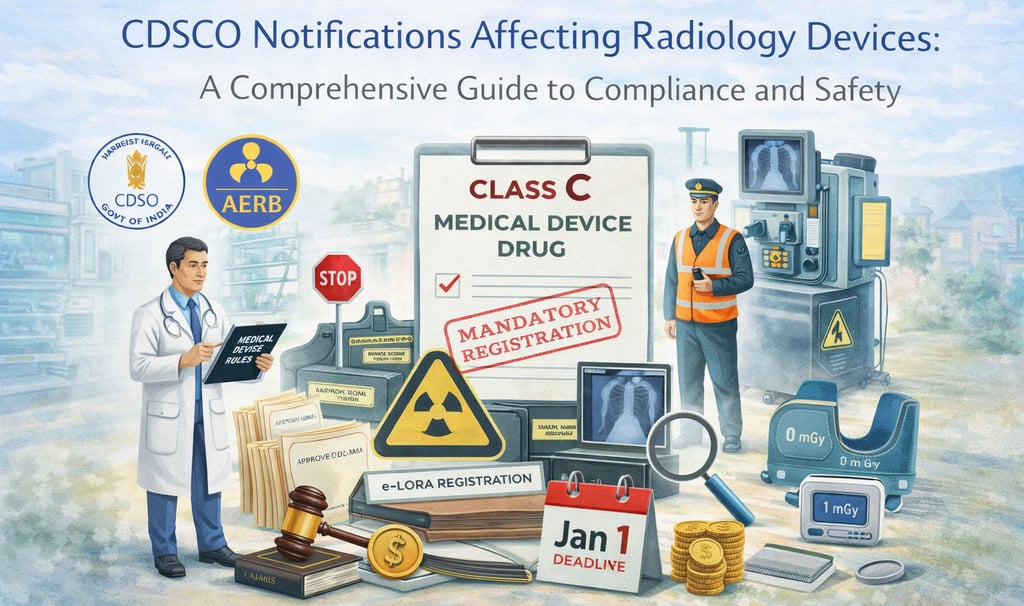
CDSCO Notifications Affecting Radiology Devices: A Comprehensive Guide to Compliance and Safety
The landscape of medical imaging in India has undergone a profound regulatory transformation. For decades, the primary oversight for X-ray generating equipment (XGE) was the Atomic Energy Regulatory Board (AERB), which focused on radiological safety. However, recent notifications from the Central Drugs Standard Control Organization (CDSCO) have introduced a mandatory dual-track compliance system. Under these new rules, radiology devices are no longer just radiation sources; they are legally classified as "drugs" and "Class C medical devices".
Navigating these CDSCO notifications is critical for manufacturers, importers, and healthcare facilities to avoid supply chain disruptions, financial overheads, and legal penalties under the Atomic Energy Act, 1962.
1. The Landmark Reclassification: From Machines to "Drugs"
The most significant shift in radiology regulation occurred with Notification number 648(E). This notification clarified that several types of medical equipment, including X-ray machines, are to be considered "drugs" under the Medical Device Rules, 2017, effective from April 1, 2020.
Definition of the Ambit: The CDSCO now defines radiology devices as instruments or apparatuses used specially for human beings or animals that assist in diagnosis, monitoring, or treatment without achieving their primary action through pharmacological means.
Specific Intended Use: For X-ray machines, the notified intended use is the application of X-rays to diagnose or treat patients by imaging internal structures to assess abnormalities.
Risk-Based Classification: Radiology devices, including CT scans, MRI machines, and PET equipment, are categorized under Class C (Moderate to High Risk).
2. Mandatory Registration: The January 1, 2021 Deadline
Following the proposal by the Ministry of Consumer Affairs, Food and Public Distribution, the CDSCO mandated that the import or manufacture of X-ray machines requires mandatory registration.
Effective Date: Mandatory registration for X-ray equipment came into effect on January 1, 2021.
The Rationale for Regulation: CDSCO implemented these notifications to address a "big spurt" in misbranded products and inferior-quality devices that were causing misdiagnosis and inaccurate results.
Consequences of Non-Compliance: Failure to register leads to regulatory gaps that can completely delay business plans and disrupt the availability of essential diagnostics.
3. The CDSCO Licensing Framework: Forms and Fees
The transition to a "drug" classification means that every stakeholder in the radiology supply chain must utilize specific CDSCO forms for legal operations.
A. Importation Pathway
Importers of X-ray equipment must navigate the "MD" series of forms to clear the Assistant Drug Controller (ADC) at ports of entry.
Form MD-14: The application for the issue of an import license for Class C or D medical devices.
Form MD-15: The official Licence to Import Medical Device granted by the CDSCO.
Associated Fees: Importers must pay $3,000 for manufacturing plant registration and $1,500 per individual product.
B. Manufacturing Pathway
Indigenous manufacturers are subject to similar rigorous documentation to ensure "built-in safety".
Form MD-7: The application for the grant of a license to manufacture Class C or D devices for sale or distribution.
Form MD-9: The official Licence to Manufacture issued by the CDSCO.
Associated Fees: Manufacturers pay ₹50,000 for plant registration and ₹1,000 per product.
4. Dual Oversight: The Intersection of CDSCO and AERB
While CDSCO manages the quality and registration of the device as a medical product, the AERB remains the Competent Authority for radiological safety.
AERB Safety Code SC-3: This code governs the design, manufacture, and operation of medical diagnostic X-ray equipment to ensure dose limits for workers and the public are not exceeded.
The e-LORA Portal: All facilities must register as an "Institute" on the e-Licensing of Radiation Applications (e-LORA) portal to conduct regulatory transactions.
Type Approval vs. Registration: A device must be Type Approved by the AERB (verifying it meets safety standards) and registered with the CDSCO (verifying it meets medical quality standards) before commercial marketing.
5. Impact on Modern Modalities: Ultraportable and Handheld Systems
Recent advancements have led to the rise of Ultraportable (UP) and handheld X-ray systems, which are now subject to these combined regulations.
Portability Definitions: AERB defines portable equipment as units intended to be moved between locations by one or two persons, with a weight not exceeding 12 kg.
Community Screening: UP systems paired with AI-powered CAD (Computer-Aided Detection) software are "ideal tools" for Tuberculosis (TB) screening in rural areas.
Safety Benchmarks: Handheld devices must utilize high-frequency constant potential generators (e.g., Nomad Pro) to optimize radiation quality and reduce patient dose.
Mandatory Accessories: CDSCO and AERB notifications require the use of lead aprons (0.25 mm lead eqv) and TLD (Thermoluminescent Dosimeter) badges for all personnel monitoring.
6. Operational Compliance Checklist for Facilities
To ensure ongoing compliance with CDSCO and AERB standards, facilities must adhere to a "Step-by-Step" operational model.
Radiological Safety Officer (RSO): Every facility must designate an approved RSO—typically a radiologist or technologist with three years of experience for CT/IR facilities.
Quality Assurance (QA) Periodic Tests: Facilities must ensure periodic QA of equipment is carried out by authorized agencies once every two years.
Technical Tolerances:
Operating Potential (kVp): Must be within ± 5 kV.
Timer Accuracy: Error must not exceed ± 10%.
Radiation Leakage: Must be < 1 mGy in one hour at 1 meter for radiography units and < 0.25 mGy/hour for dental intra-oral units.
7. Administrative Protocols and Record Keeping
The CDSCO and AERB emphasize meticulous documentation as objective evidence of quality and safety.
Personnel Monitoring Service (PMS): TLD badges must be exchanged quarterly for a Quarterly Dose Report.
Safety Status Reports: The Licensee must submit periodic safety reports via e-LORA.
Decommissioning: When equipment is no longer in use, it must be decommissioned by authorized agencies with prior intimation to the AERB to ensure components like X-ray tubes are disposed of safely.
Conclusion: Achieving Radiological Excellence through Trust
The integration of CDSCO notifications into the radiology sector is a strategic move toward Expertise, Authoritativeness, and Trustworthiness (E-E-A-T). By treating X-ray devices with the same rigor as drugs, the Indian government has established a framework that prioritizes patient safety and diagnostic accuracy.
A good diagnostic procedure is one that provides the optimum quality information at the lowest radiation risk, adhering to the ALARA (As Low As Reasonably Achievable) principle. Success in the modern Indian market requires stakeholders to look beyond the hardware and commit to the religious adherence of MD-15 registration, AERB Type Approval, and biennial Quality Assurance. Compliance is no longer an option—it is the legal foundation for protecting human health and the environment in a high-tech imaging era.
About XRAYNEWS.NET
XRAYNEWS.NET is an independent news site for India's medical X-ray and radiology community. Edited from Chittorgarh, Rajasthan. Write to us: info@xraynews.net
Regulatory Resources
© 2026 XRAYNEWS.NET. All rights reserved.
Video Resources
Popular Topics
Quick Links
Stay Updated with X-Ray Industry News
Subscribe to receive updates on X-ray technology developments, radiography insights, and industry news.